

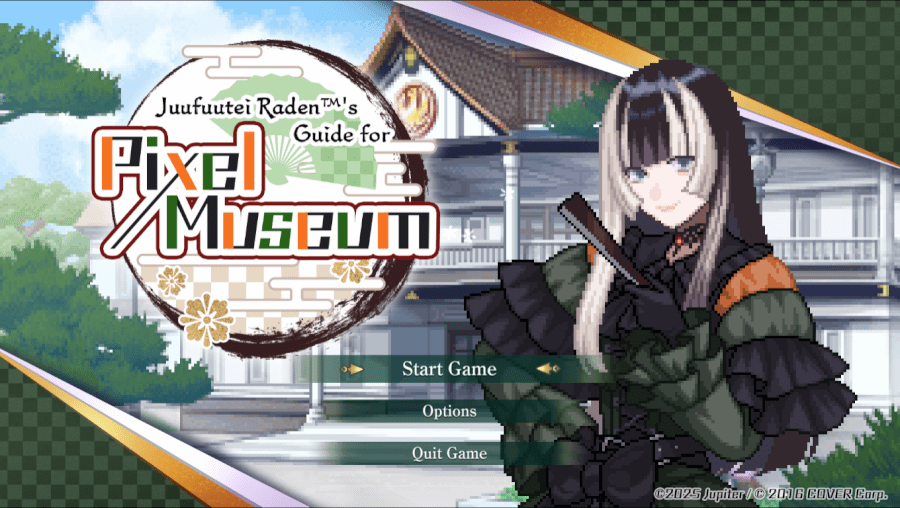
I usually stick to Nintendo consoles for Picross titles, but since this is basically the first time Jupiter releases one of their Picross game across multiple platforms (and it was on sale) i opted for the Steam version, this is also on Switch and it has since released on PS4/PS5 and Xbox consoles too.
Plus, i figured it would be a perfect fit for mouse controls… and it is.
The only difference is that Nintendo owns the Picross brand, so the Steam and other releases just drop the “Picross” moniker from the title, and refer to the puzzles themselves as “picture puzzles”, as in nonograms, more commonly known for the “sudoku” type of configuration.
Seems kinda pointless to discuss gameplay as the series has basically been Jupiter’s Dynasty Warriors, meaning they put out a lot of Picross games that basically play the same (even more than most Dynasty Warriors subseries, actually) but have a different license/s sticked onto to entice the various fanbases into trying the formula, like the Kemono Friends one, the Overlord one, and this time Hololive themed, specifically about Juufutei Raden from the REGLOSS unit.
To be fair, they also do this because these games are virtual versions of nonogram puzzles (like sudoku) that you could play with just pen and paper, these are logic puzzles – in case you didn’t know – where you’re given a graph with a number for each row and column, indicating how many of the squares/pixels have to be drawn/colored in, letting you suss out which and how these can be, by using logic and the way the number are displayed for each row or column.
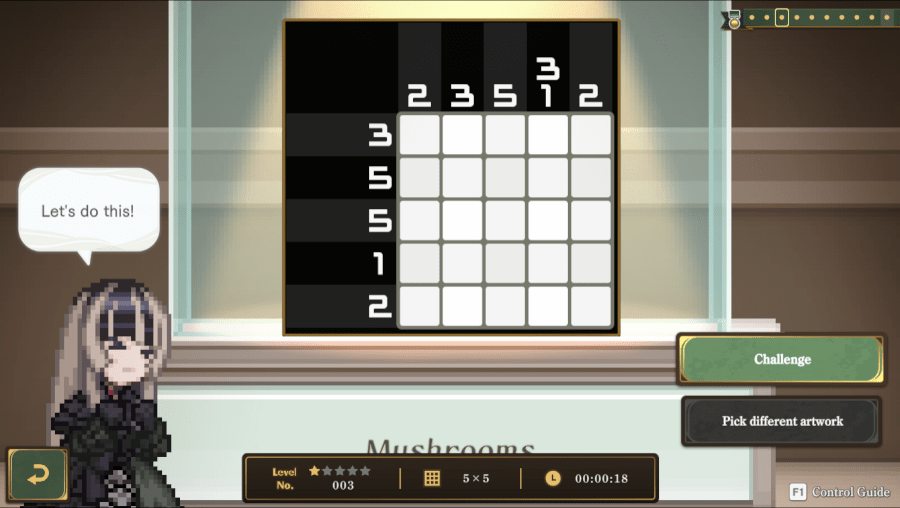
When you draw/color it in right, you win and you get a stylized pixel image representing a character, object, landscape, and so on.
You move onto the next, and the puzzles get more difficult as they become larger, requiring more logic and pondering to find the correct way, with less forgiving combinations of specific tiles needing to be colored it.
Like every good puzzle game, it sound more difficult when explained than when played, it’s deceptively simple to get the hang of, but i will say this one also has a very solid tutorial and offers the usual commodities, like highlighting the numbers indicating the pixels to be colored/drawn in are divided in blocks, letting you decide to get a random hint at the beginning of the puzzle, and all the accessibilities option you’d expect, including turning off some systems that help suss out where to start “logicing away” at the pixellated picture, if you wanna be a total purist.
If you played any of the more modern Picross games, like the Picross E titles, you won’t need any of that though, but most people that haven’t played Picross will, and this being a “gateway game” for Vtubers/Hololive fans, with the framing being chaperoned around an interactive pixel museum by Raden, whom is more known for her viral “matsutake dance song” of some years ago, despite being a bonafide art buff fluent in both japanese and western spheres of interest on the subject, from painting to sculptures, architecture, performing arts, etc.
Since gameplay is exactly the same ol’ Picross (which is still good, even if Picross 3D is even better), more specifically the framework for the Picross S subseries, the theming is important… and this one sells it incredibly well.
even though its kinda odd the game basically forces you to bring up the puzzle list to basically teleport between the various themes-subjects the puzzles themselves are divided into (japanese art, sculptures, lacquerware, western paintings, etc.) instead of having 2 seconds of Raden’s pixel model walking from that section of the museum to the closest in proximity-access, or having to reselect the last puzzle you were about to confront, though from the main in-game museum menù you’ll enter the exhibit in the last theme you were playing or finished a picross in.
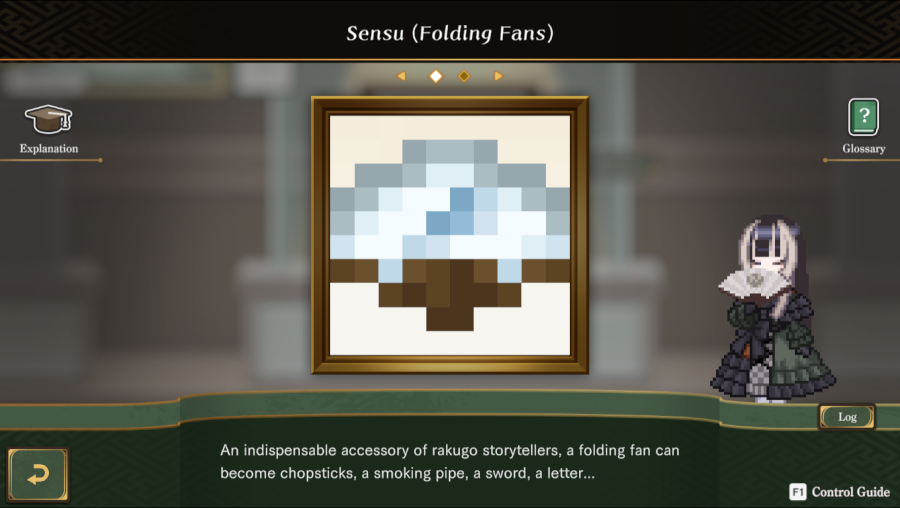
sure, for most the appeal will be being able to hear the recorded lines and having Raden go on explaining about historical japanese fans and comment on classic western paintings, but the game has a good glossary you can bring up if you’re not familiar with some highlighted terms, so it is indeed a virtual museum trip, very informative and comprehensive in terms of the arts display, which skews on the Japanese side of things but also include a lot of the more famous western paintings, sculptures and such.
In a more general sense, the explanations are quite well done, not overly long but informative, not overly short, so it works even if you come in not caring or interested in v-tubers.
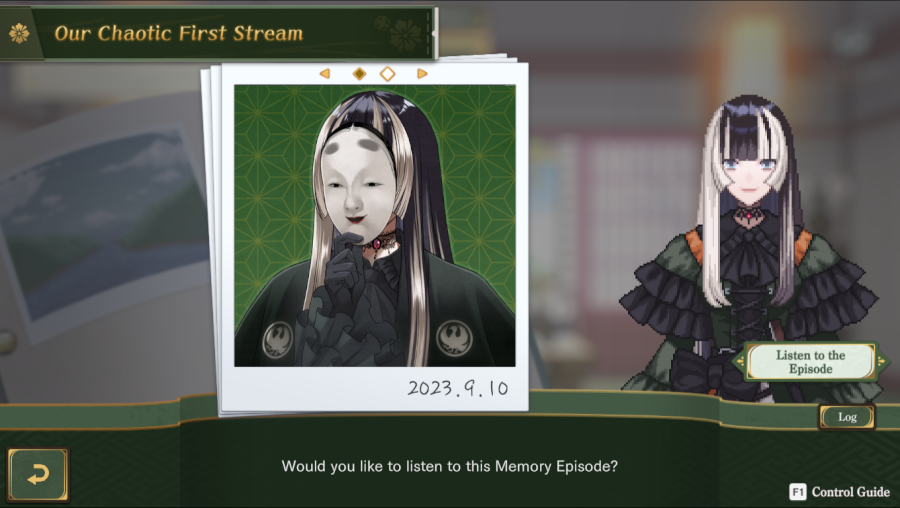
It’s also fairly… decently in terms of content, with the main exhibits containing 150 picture puzzles, plus more in terms of Clip Picrosses (not called that, but working the same as the Clip Picrosses introduced in the Picross S subseries, as in, a big Picross made out of 20 or more smaller Picrosses), here relegated to Raden’s private curator room upstairs, which instead of an explanation for an art piece net you a story about Raden and her REGLOSS genmates.
there are no Color Picrosses, but i didn’t really expect them, though other licensed titles like the Rising Of Shield Hero Picross had them. That aside, the game has about short of 400 puzzles total, fairly meaty, but not too impressive (even Kemono Friends Picross had a little bit more content), still more than enough to keep most Picross fans busy, but also more than enough for newcomers to dig into without feeling overwhelmed if they do end up liking the formula and maybe even decide to go for completition.
I still would have liked a handful of Mega Picrosses instead of the Clip Picrosses, personally, but it definitely does have enough to justify it’s 20 bucks MSRP, i feel you’ll definitely get your money’s worth.
And while not the biggest Picross title in terms of content, it makes up for that with the difficulty of the picrosses’ difficulties, as they tend to be on the harder side of things (though mileage may vary on how much of a hardened Picross player you’are), which i will admit could be discouraging since, aside from the tutorial section of puzzles, the difficulty isn’t scaled as you might think, or how it is in other games of the series like the Picross S titles.
Sure, each picross puzzle shows a difficulty rank alongside the extension of the grid (how big is the puzzle itself), but for example, if you try to play them in sequence, you might go from a very mild one to a difficult or a VERY difficult one.
speaking of, since the 5 stars picrosses are very difficult and huge, it’s good to have a suspend feature, as these few uber hard puzzles can require hours, but oddly no in-game zoom feature, which might or not be an issue depending on your monitor size, but it would have been helpful to have a little zoom slider, since unlike on Switch, on PC you can’t do the manual zoom in thingie.
so it’s not exactly what i would recommend for an entry point, but it can work as such.
It’s not a huge issue as you don’t need to do puzzles in any order, nothing stops you from jumping to a complete different themed set/themed hall/specific art type and do another one that might be far easier, as the difficulty is more scaled to the importance implicitly given to the art piece itself.
Kinda, sorta, because it’s kinda pointless to say glass art is inferior or superior to painting or sculpture, or that lacquerware isn’t a craft worth displaying in a museum.
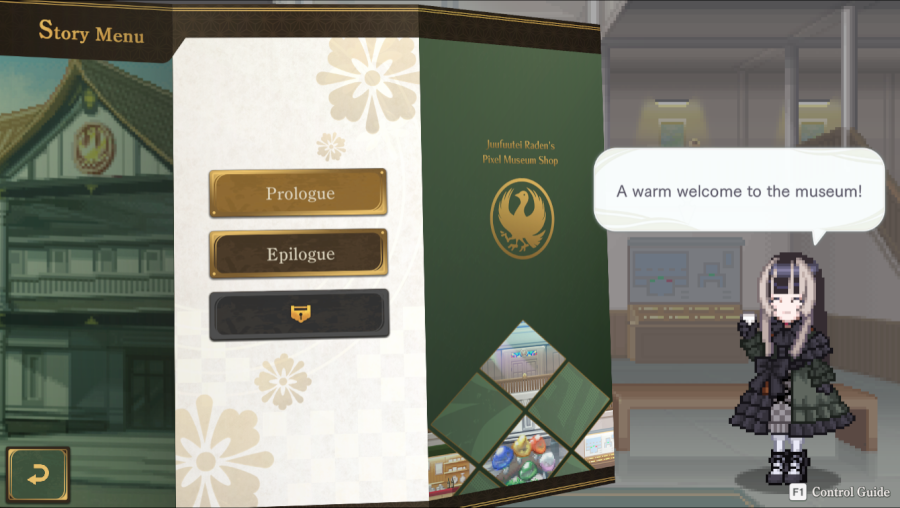
The only requirement is that you need to do at least half the picrosses in each themed hall/museum wing/category to unlock the section/category’s specialty puzzle, and there’s actually some sort of narrative, kinda, by that i mean aside from the prologue there are also a “finale” and a “secret ending” cutscenes to unlock, which are very brief cutscenes, but do help in motivating the player by giving them something to works towards, instead of just being a virtual version of stuff you could do on paper.
While music is good, there are few tracks for the picrosses’ background music (and the instrumental museum music that plays on the main menus), so it might have been wise to add either more relaxing tunes akin to the museum theme, or use the opportunity to feature some of REGLOSS original tracks, Raden is part of a idol agency after all.
the latter wouldn’t have fit the theme, not really, and might have caused licensing issues over time, either way some more music tracks would have been welcome, especially as on the harder picrosses you will listen a lot to one of the few tracks available.
While not the perfect game to easy newcomers into the “picross boogie”, Juufuutei Raden’s Guide For Pixel Museum is definitely better than some of the other licensed Picross titled, for example presentation is far better than Kemono Friends Picross or the Overlord (the isekai with the big ass lich, that one) one, music is familiar but fitting and good, and there are many voice clips and commentaries by Raden on the various art pieces and subjects, and given the subject and framing, there’s an easy to access glossary in case some expressions or terms might not be familiar, which is bound to happen eventually for most people.
Pretty good.
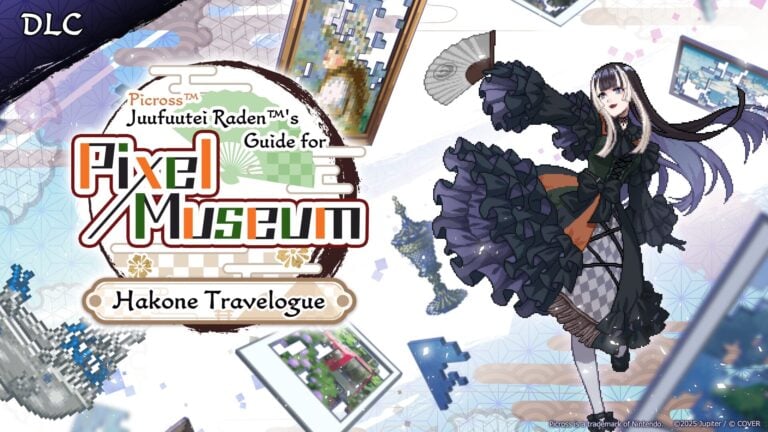
Also, coincidentally, a week ago they announced a DLC based on the region of Hakone (which include collabs with regional museums and businesses of Hakone), with 30 new themed picross puzzles, 3 new memory puzzles, new commentary and new BGMs, scheduled for this December, we don’t know the price, but i would assume 5, 10 bucks at max.

