
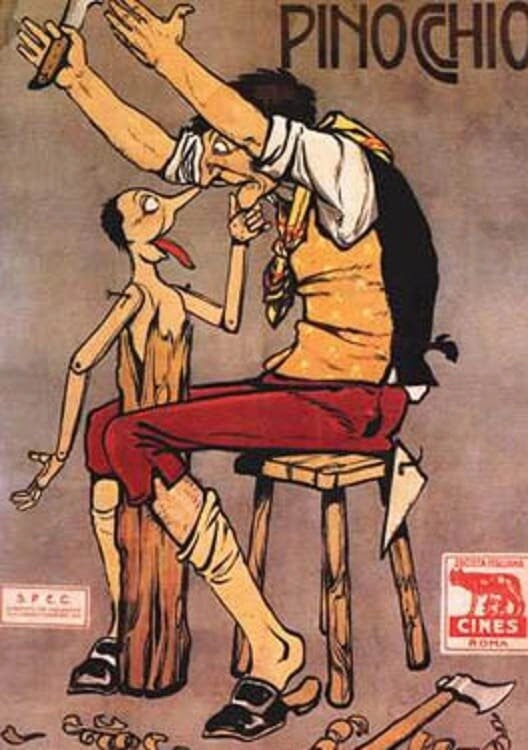
For the record, i absolutely detest how more than 60% (to be kind) of these Pinocchio adaptations are often called or retitled for international releases as “The Adventures Of Pinocchio”.
I get why, but still, at least opt for simply “Pinocchio”, makes it easier to search for even if we still have to put the decade after the title to avoid confusion, not that it would help too much because “Pinocchio (’11)” we’re talking about today was not made in “2011”, but the other “’11”, as in 1911.
We’re going back in time as hard as we can this time, since this is the very first movie adaptation of Collodi’s novel, an italian production as one could assume, and given its 112 years old, its no wonder it has been considered a lost film for decades, then in 1994 a negative was found, a 30-minute version resurfaced in 2022, and in 2018 we got a 50 minute version restored in 2K from the original negative with more footage taken from a positive nitrate copy and another negative (with different color tints), now both stored in a national Italian cinema archive.
There’s also a 42 minutes version that was screened at the Zorrilla Theathre in Spain in 2018, which (for some reason) added electronic music executed live by the band Miclono to the silent footage, which can be found floating around the web, alongside the 50 minutes version, which i’m basing this review on, and can be found on Youtube, and it’s public domain stuff you can get from the Internet Archive.
It’s not a complete restoration as the current 50 minutes version restores 1086 meters of the 1203 meters long original film, but it’s almost complete, and who knows, maybe in time we’ll be able to see an integral restoration of the very first Pinocchio film adaptation.

Pinocchio-meter:
The basic premise follows Collodi’s novel, at least as in it’s about Pinocchio, a wooden boy born out of a wood log that comes to life, and initially you’d think it would be quite the faithful adaptation, as it includes Gepetto being arrested for basically harboring this wooden monster humanoid that as soon as it’s borne, makes havoc in the city, there’s the “feet burning by the bonfire” scene, heck, even the often esponged minor scene of Pinocchio being tied to a doghouse and acting as a dog to scare thieves away… but it soon does whatever the fuck it wants, so to speak.
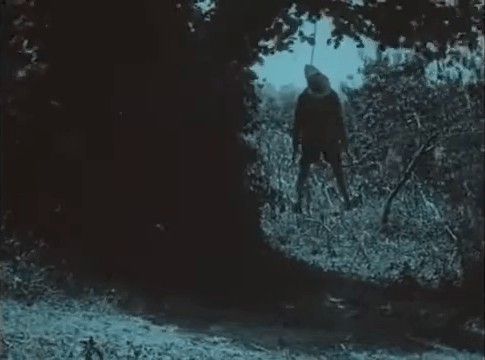
Mind you, the characters from the book are what you’d expect, and there is a Cat and Fox duo that con him to bury his gold, there’s the “Whale” (it’s not actually a whale, but whatever) scene where he gets eaten and meets Gepetto inside of the animal, the circus with the living toy performers, even the hanging scene, but it’s pretty obvious director Giulio Antamoro was about to do what a “sequence break”, because most of the events/scenes are there, but happen in a seemingly random order and often include a different ending or resolution to the scene that the canonical one.
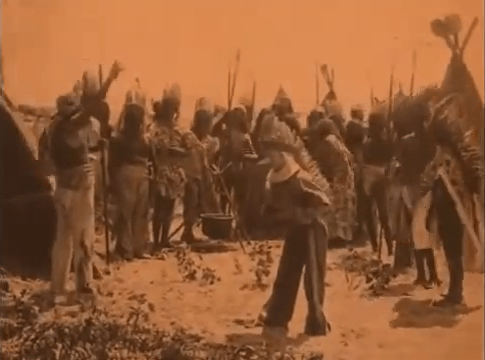
Heck, not content to basically reshuffle the book’s order of events, there’s also a completely out of nowhere sequence that see “Native Americans” hunt the whale, initially hang him over the fire, then worship him as a god, then Pinocchio runs from his followers to a camp of Canadian soldiers that kill the “Native Americans” and send Pinocchio back home the only way the can: shooting him out of a frigging cannon.
I can’t make this shit up, but then again it’s 1911 and the random ass, out-of-nowhere racism swerve is kinda to be expected, it’s also an Italian film from that era, i’m not really surprised about the “sensitive free” racial charicatures, at all. Still, it’s so out of left field i’m kinda impressed.
Real Boy Ratio:
Despite the “non-Indians Native Americans” first literally roasting Pinocchio then willing to make him God Emperor and the equally insane presence of non-Mounties that go on a native genocide… this is Pinocchio, at heart, down to the wooden boy himself being a dastardly pest immediatly after gaining sentence, though the reshuffling of events and changes kinda weaken the usual moral lesson it’s attached to Pinocchio’s adventures, as the Blue/Turquoise Fairy it’s a bit too easy on the resurrection or fix-it-all spells, instead of having Pinocchio earn them a bit so he can actually understand some values, or try to do so, at least.
But then again, probably is was to avoid also having to animate fishes eating away the drowned “donkey Pinocchio” body skin, it’s 1911, so yeah, i’m asking a bit too much.
Also taking into consideration the era it was made, most of you might already have deduced Pinocchio is not played by a young boy, and for that you’re indeed correct, he’s not, as obvious as it will be when you think about it for more than a second.
He’s no literal puppet either, funny as that would have been, but he’s played by popular Franco-Italian comedy actor, Ferdinand Guillame, better know at the time as “Polydor”, which now looks kinda creepy, unintentionally so, but still, as unplanned as the face of the “work in progress” Pinocchio being carved from the lumber just shy of a Rammstein album cover.
Speaking of which, the Cat and Fox also come off as fairly creepy, as they don’t opt for make up but just giant masks for the actors… which also leads to the duo bringing Pinocchio to the town of Acchiappacitruli (“Foolcatchers”, literally), here completely made of anthrophormic animals, in a bout of kinda surprising loyalty to the source material, gives the “American Indians” shit.
Polydor does give a good performance (again, for the era of early silent films), the rest of the cast it’s solid, keeping in mind we’re still in the infancy of the medium after centhuries of stage plays, so fittingly the movie begins with Polydor coming out of a stage curtain, then turning – via editing – into Pinocchio, jesting with the Geppetto’s actor, ending with him coming back behind the curtains, and then the movie can begin proper.
Overall Evalution
Despite the movie being kind of all over the place in terms of adapting the scenes (remember when Pinocchio is confronted by a literal elephant man in a tavern or when he’s captured by “Native Americans”, worshipped by them and then saved via a cannonball escape by Canadian soldiers?)… it’s actually pretty fun, well directed for a film from the 1910’s, with a minimal usage of title cards to give the audience some basic info to work with (after all, it was made in Italy and even by then the book was quite famous), and with its runtime under 60 minutes in this almost complete restoration copy done in 2018…. for the first film adaptation ever of Pinocchio it’s pretty good.
It’s kind of an acquired taste for most people nowadays, and the random ass original scenes that this movie makes up are also randomly racist , but to the cinema buffs and the always curious film scholars, the prospect of a long considered lost silent Pinocchio film made in its homecountry, now almost completely restored and easy to access, it’s an obvious recommendation, and it’s an entertaining piece of cinema from its hayday, on top of its historical value.
 Wise Cafe (International)