
HISTORY
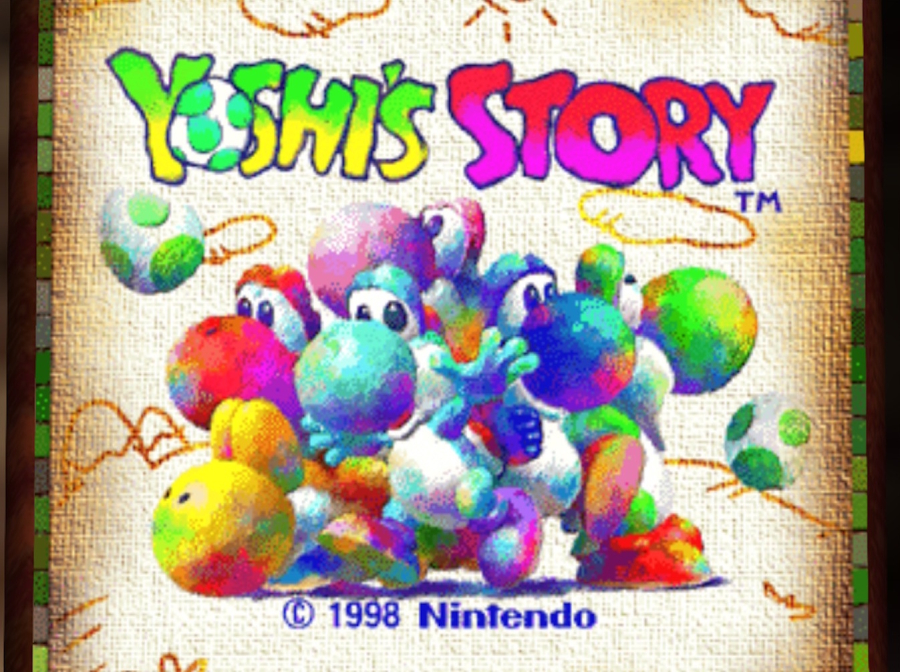
While nowadays the Yoshi Island subseries has mixed reception, the original sequel to Super Mario World was indeed (and still is) a classic, peculiar spin-off of the Mario formula, and Yoshi Story was the first follow up/sequel of sort to reiterate on the formula, developed by pretty much all the original team for the original Yoshi’s Island, minus Shigeru Miyamoto, here just supervisor instead of producer or director, that here being Hideki Konno, whose portfolio already included the original Yoshi’s Island and Super Mario Kart.
This one doesn’t have much in terms of production history or weird tidbits about its inception.
It was originally just called Yoshi Island 64 and meant for the ill-fated Japan only N64DD peripheral, the game – like many others – was moved from the floppy drive format to cartridge, and when revealed it was meant to also “flex” the 3D capabilities of the N64 alongside its 2D craft, which was peculiar of a stance to take when 3D was the new fangled tech and the industry was more than happy to join on the bandwagon of immediatly shaming the previous tech as obsolete junk in favour of “the future”, regardless the fact that in this case 3D turned out to be the future.
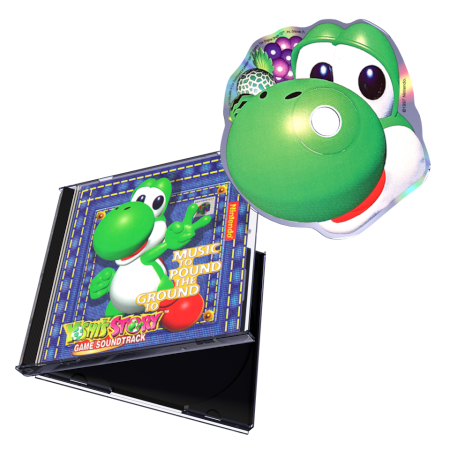
Also yes, you might remember this one in how Nintendo made the soundtrack available on a CD shaped like Yoshi’s face, similar to the one for Diddy Kong Racing.
While i possess a copy of its Virtual Console rerelease back on the Wii, i have used the version included in the N64 Nintendo Classics catalogue for Switch and Switch 2 (which requires to also have the Expansion Pak tier subscription), and yes, it was also available on the chinese N64-based IQue Player.
PLOT & GRAPHICS
If there’s a Yoshi Island series subcontinuity (which i’m sure will make little sense since these game often have baby versions of characters that do not share the same exact world), this is not what you’d expect, because these Yoshi Island games are basically reboots and exist as their own thing.
Maybe there’s a theory about this, but honestly i don’t really care, and to demonstrate my point of this not being a sequel, there are no baby versions of the characters… but Yoshi exists, maybe as a singular fixed entity in the multiverse.
Jokes aside, the plot is about as simple as it gets…. or is it?
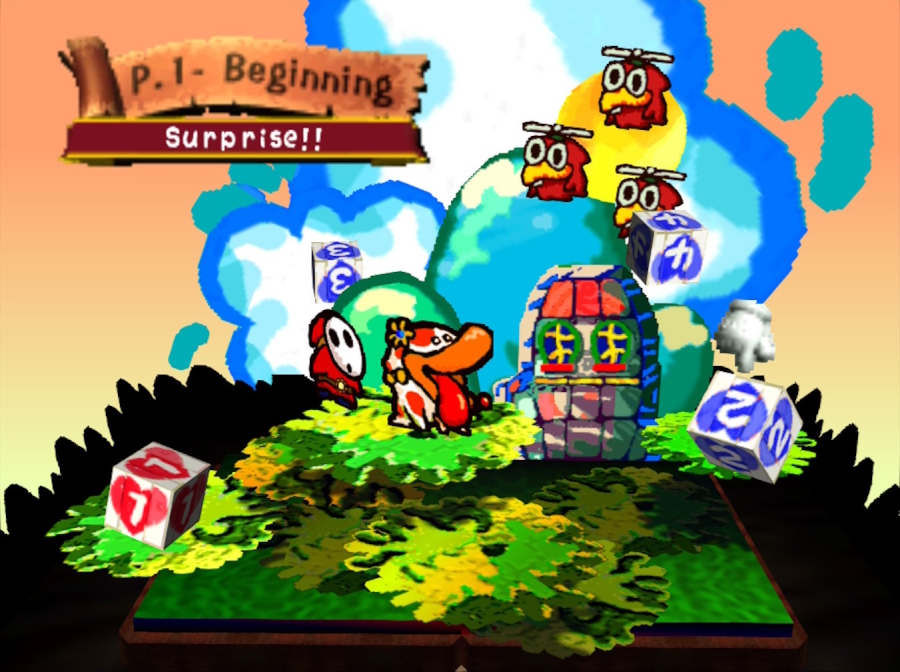
The Yoshi live in perpetual bliss in their island thanks to the fruits grown by the Super Happy Tree, but Bowser Jr. becomes jealous of them, so he casts a spell to transform the island in a pop-up book and steals the Super Happy Tree, causing the Yoshis to… well, become depressed and gloomy.
Thankfully six eggs survive the event and so, once they’re born, they realize something is wrong and venture into the pop-up book to retrieve the Super Happy Tree from Bowser Jr., holed up in its castle…
This is basically a kid friendly version of We Happy Few’s plot, there IS a populace kept blissful by a drug that they take to not be suicidal or depressed, non-synthetic in nature, but still…
This is some Orwellian shit, just shy of a Minister Of Truth removing any mention of the “Dark Age of Yoshi Island” where serfs were a thing, the Yoshi Island manual of “doublethink” or saying that “Big Mario” is indeed watching them.
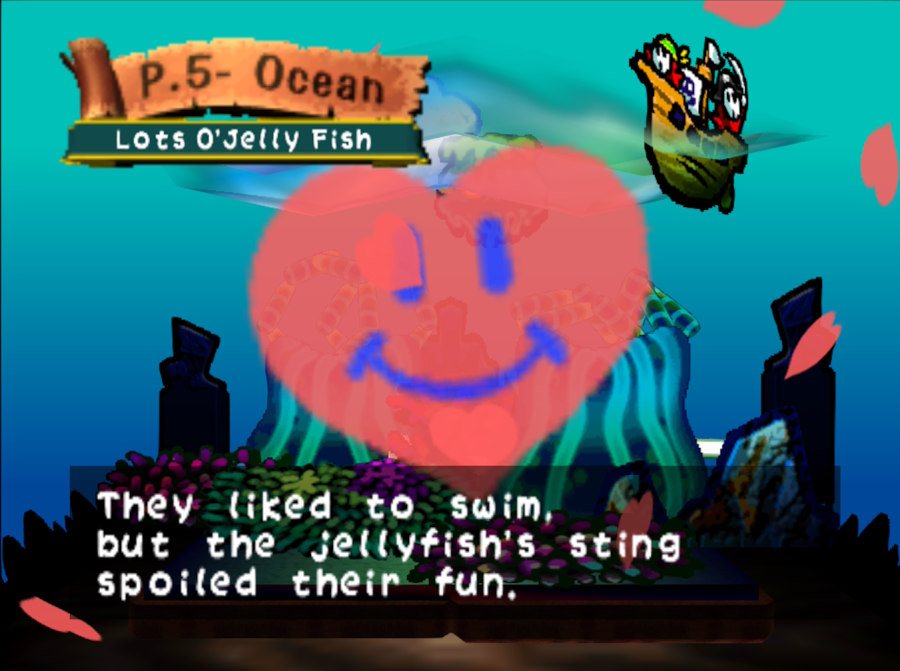
The main attraction and a distinctive choice that will influence later games in the Yoshi subseries is the pop-up-book aesthetic, which does fit the series and i gotta say, the mixture of 2D and 3D is great, the models are obviously choppy by today’s standards, but the art direction made this age beautifully, heck, arguably even the plasticy look the levels is more charming than intended, as it look crude but the overall stilization still make this a very good looking game.
While at times it’s a bit too cute and child friendly in terms of sound effects and music, i do like how the soundtrack adapts to Yoshi’s health/mood, so you can hear the level theme change depending on how hurt he is, and honestly i think it’s an underrated soundtrack by Kazumi Totaka (an often overlooked Nintendo composer that worked on a lot of stuff, from Super Mario Land 2: 6 Golden Coins to Wave Race 64 and Wii Music, and notoriously likes to hide a 19 note song as easter egg in many Nintendo tiles); it has some familiar Nintendo tunes but also some odd remixes, like the rap one of the original Yoshi Island theme, or the “jungle theme”, i think it’s perfect for the kind of game this is, it captures perfectly that vibe of being a kid and vocalizing-humming the tunes in a fun way to amuse yourself, and overall is fuckin adorable and happy.
GAMEPLAY & LEVEL DESIGN
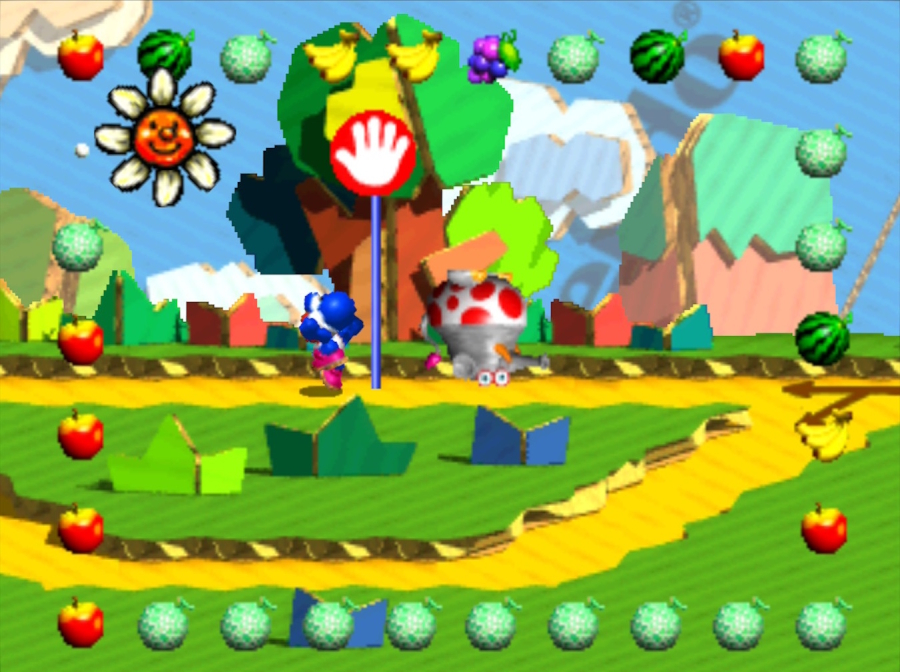
Yoshi Story as expected builds off Yoshi’s Island for its gameplay fundamentals, going for a 2.5D feel even though there’s no intersecting section of the sidescrolling or use of the foreground and background, like for example in Klonoa, so even with 3D models and use of polygons, the game is purely a 2D affair in terms of actual gameplay, just sometimes having split paths, and more often enemies in the foreground try to lob things at you or similar ways of impede your progression.
There is some streamlining as Yoshi automatically creates an egg projectile after eating an enemy, no need to manually lay it (though this means you can’t eat and spit back enemies or other items), and some systems are missing, like eggs do not longer ricochet off walls, plus since there’s no babysitting baby version of Mario, Luigi or other Mario series characters to deal with, so you have a regular health bar you can replenish with fruits, and Yoshi also has an unique ability exclusive to this game: sniffing.
Yes the “sniffa sniffa”, as in, a dog style sniffing makes Yoshi focus on finding secrets, with the screen zooming in so the animation makes it extra clear if you’re close to a secret and how much, and then using the old butt stomp to reveal it.
What is even more unique is what the game considers “victory”, as in, instead of reaching the designated level end/goal signpost, you need to eat/collect 30 fruits to pass/finish the stage.
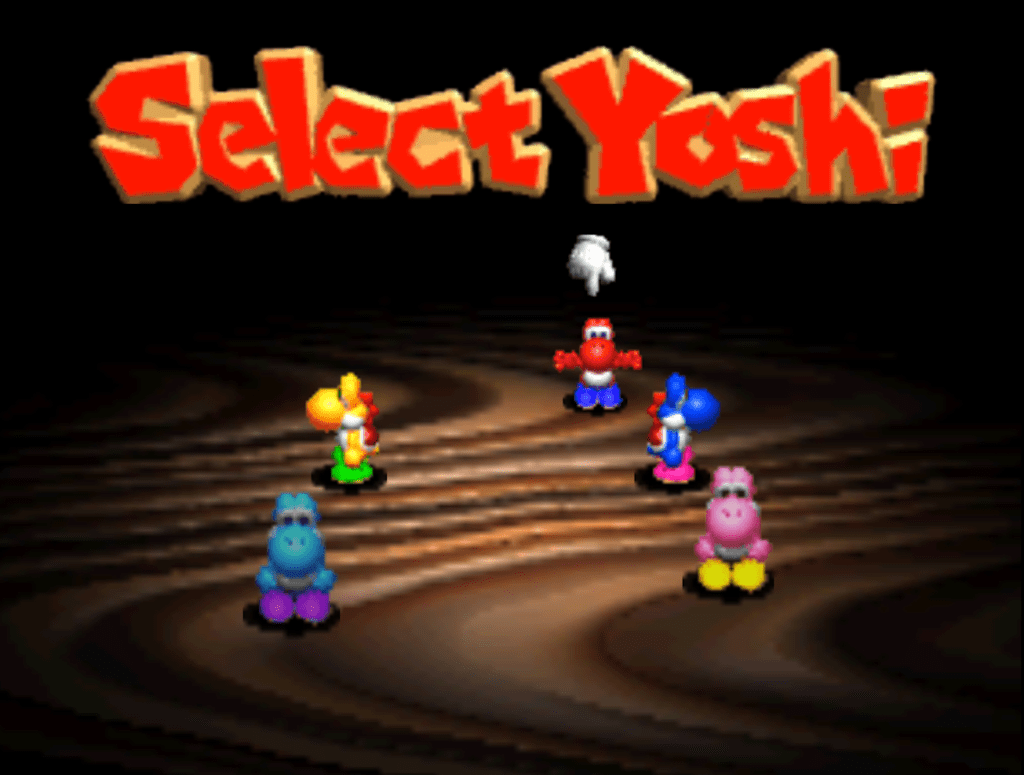
This is built into the interface with the border showing the collected fruits and (alongside messages that warn you that you just need 5 or just one more), and it’s a strange system, it is, but one that does make sense (even if due to this UI choice sometimes can be confusing since they might overlap with some fruits hidden on ceilings) once you consider the game has also looping levels and unorthodox lives system at plays, with that Yoshi selection screen before each stage being an indirect way of telling you how many lives you have left.
Yeah, it does remind me of that Disgaea spin-off, Prinny: Can I Really Be The Hero?!, since Yoshi’s Story basically gives the player a limited and numbered stock of extra lives.
It also peculiar how the game is engineered to reward people going for high scores, as for example eating only melons will get you a specific high multiplier, but finding 30 melons in each level is feat in itself that requires using all the tricks (including the new “sniffing” mechanic),
And you’re encouraged after a while to go for the high score and avoid picking up most fruit because you wanna explore more in search of the Hearts to unlock more stages, and this regard the time warp thingies help in doing backtracking, as weird as that might sound given the looping levels and the unorthodox conditions for a “level clear” the game has.
Since the game doesn’t factor in time into the scoring system and multipliers, you’re encouraged to carefully explore every nook and cranny for a perfect run, if you’re so inclined, because there is no time penalty, so take your time.
To be clear, while the levels themselves are actually designed and not randomly generated, they don’t have a classic “goal/end”, so they loop, hence why there are warp points you can activate and travel to, and while some levels don’t have a boss encounter at the end, those who do just teleport you to the boss room/area upon getting the 30 fruits.
Level design is mixed, as in, some levels are very good, have unique ideas, but some are so notably lesser than others, especially when they redo a lot of overly familiar elements from either the original Yoshi’s Island or Mario games as a whole, or do something that’s honestly kinda annoying more than fun, like the “sky snakes” one.
It’s either heaven or hell, so to speak, so while it’s still decent overall, it make you wish for something less uneven or with better gimmicks, as some are cool but are basically gone and forgotten as quick as they’re introduced.
DIFFICULTY & LENGHT
Despite the comparison to the Disgaea Prinny platformer game made earlier, this isn’t that kind of sadistic experience.
For example, here you can actually recover a lost/captured Yoshi if you find the secret silver Shy Guys hidden in the stages
Still, it’s on the Easy side of things, you’d expect as such from a Yoshi game, but i wonder how the original Japanese release was, since it was criticized for being too easy (among other things), so they increase the challenge and did many fixes and added things (like a save feature for story mode, so you could resume on the last act/chapter reached, instead of having to do it all in one go) for the international releases.
It’s still quite easy, even more due to the lack of a “baby” to protect from Kamek and his childnapping lackies, which helped the original Yoshi Island still have immediate stakes.
Also, Yoshi’s Story compensates on this by being designed as a game you are meant to replay multiple times, since a regular run will take about 2 hours each, and to play/unlock all 24 stages (to be available in the Trial Mode you’ll have to least play a stage at least once) you’ll have to do at least 4 playthroughs.
The levels aren’t short per sé, but due to the way progress is determined by the fruit target and there being more optional-secret rooms and challenges, some like the melon boxes balancing trials that can’t be tried again without redoing the stage from scratch, you might spend more time trying to find all the stuff or replay the stage in a later run.
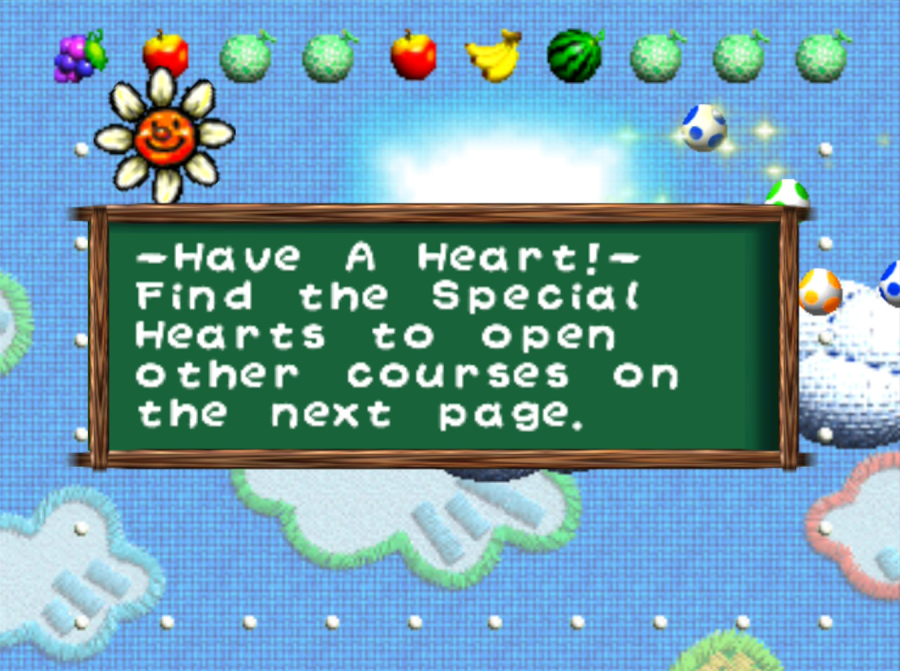
Plus, i do mean you have to replay the game multiple times, because while the fist chapter has you choose from 4 levels, in the following chapter the number of available levels depends on how many of the 3 secret hearts you found in the previously played levels, so if you get all 3 of these very big hearts in a Chapter 1 level, you can select from all the levels of Chapter 2, and so on.
To that extend there is a “free mode”, confusingly called “Trial Mode”, i guess in the sense you can replay the unlocked/played levels there and see the best level results/records, and in a way the scoring system rewards the players who can do the more efficient runs, finding all collectables, doing some of the optional mini-games like the aforementioned melon run, and scoring makes for a puzzle-esque approach, since eating the same fruit in a row gives you bonus points, so does eating the Yoshi’s favourite fruit (which is randomly selected slot machine style by the game at the beginning of a run), Yoshis of a certain color get extra points for eating a specific fruit, and the melons also are the most point rich items, so score attack chasers are gonna be inclined to go for a “full melon run”
funnily, if you attempt to get a perfect melon run for each level the difficultu will reverse from super easy to Dante Must Die, in a way, which is an unique way to go about difficulty settings.
I do think there are some cool or unique ideas here, there are some nice ideas like the blind ghosts that react to loud noises for the levels, but some are secret for its own sake and it would have been better if the game actually explained better than there’s more to unlock and see and hinted better at how to achieve such, or encouraged it more.
the game does explain some of these systems and quirks better on the second run, ironically if you decided to explore the other levels you couldn’t or wouldn’t do on the first run (again, due to the game proceeding to the next chapter after every level) there will be info boxes blocks that tell you stuff like how the Special Hearts are key to unlock more levels in the next chapter to select from, how to pick up audio cues to the Hearts when you’re close to them.
And boy these info blocks make it extra clear the “very young” target audience, afraid that the crayon munchers might forget START makes you pause the game, for example.
even so, it’s not a very long game, even if you go for completition instead of just doing a run or two and calling it quits, even if you are okay with the way its meant to be replayed over and over, you won’t be playing this for 30 hours or something like that, not that you should, but yeah, either more levels to unlock or a more rewarding system to encourage players for completing it would have helped, as i don’t believe completionist will take more than 10/12 hours to 100 % the thing.
Which isn’t bad, but also not quite great.
OVERALL EVALUATION
Timing is everything, or at least more pivotal to success than quality, because nowadays we are used to have once again old school 2D or 2.5D platformers, as nostalgia and an industry ever grasping to not implode make old fashioned sensibilities palatable once again.
Back in 1997 instead Yoshi’s Story was old news, as gaming was undergoing the transition from 2D to actual 3D, with all the compromises and the issues that arise from a sea change of such magnitude, such as immediatly discarding the old stuff as decrepit, something to immediatly throw out of the toybox lest its rot kept festering.
After all, media industries in general had always pushed the “long live the new flesh” motto on the basis of it being new, and the gaming industry was (and still is) no different.
Plus, the platforming genre itself had just leaped into proper 3D with Nintendo’s own Super Mario 64, while Playstation born contenders offered a new attitude to attract the teen demographic more… so Yoshi Island stuck out immediatly, being a 2D game using prerendered 3D graphics AND clearly targeting itself at a very young age group, made even more clear by its arts and crafts aesthetic.
So yeah, i do believe Yoshi Story was indeed a bit of a misunderstood title, releasing at the wrong time par excellence, but even those who didn’t give less of a shit about the optics of playing a “children’s game” or that understood its game design philosophy….most likely didn’t want it either.
Most people wanted Yoshi Island 2 from a game that instead was built more in terms of score attack, emphasizing a puzzle-esque approach to how you explore and reach the unorthodox goal of eating a fruit quota, and tried many peculiar ideas, like levels that loop, an indirect limited number of lives and encouraging exploration to unlock a bigger pool of levels to access during a Story Mode run, with the game progressing automatically the next chapter after a level is completed in each chapter-world.
Even if not all of these ideas didn’t work out, the game can’t be faulted for at least attempting something that is still (mostly) unique today, where it could have easily replicate the original Yoshi Island and easily please the fans this way, but it’s undeniable how it was also skewed to be even easier than its precedessor, to the point the storybook progression style was most likely made to make younger player get to the end and feel satisfied, again, ideally the target audience is so young it won’t care too much (or at all) how short a run can be,
It still being a fairly brief title even for completitionists would have been easier to gloss over if the level design wasn’t as uneven as it is, with some great levels back to back with notably less inspired or downright annoying ones, so overall Yoshi Story is not a mere curiosity or a bad game, but it sits in that akward “more than decent but not quite good” limbo.
It’s definitely far better than Yoshi’s New Island, you can quote me on that.
LEGACY
If nothing else, Nintendo did committ to make Yoshi Story very available and fairly easy to experience since (aside its release on the chinese IQue Player) it was first rereleased on the Virtual Console for the original Wii, the Wii U one, and then again include in the Nintendo Classics lineup for Nintendo Switch (and then Switch 2) as part of the Expansion Pak premium tier subscription package.
So at least since 2007 it has been easily accessible, but it wasn’t forgotten entirely, as Nintendo kept sneaking characters from it in Smash Bros Melee (like the elephant “enemy”), uses the theme for a GBA tech demo thingie, and you can argue it served as a sorta precursor to Yoshi’s Crafted World (as Yoshi’s Wooly World was more influenced by Good Feel previous Kirby’s Epic Yarn) in terms of themes, aesthetic and even some design choices for the 2.5D approach.
If Nintendo ever gets around to do a N64 Classic mini-console, i’d be surprised if they didn’t include this title, especially since it’s still a niche entry in the Yoshi subseries, but as usual, we’ll see, it’s Nintendo, they might never do those mini-consoles or not, they made a Pokemon Red & Blue collection of tapes with tunes of the old games to play on a Game Boy shaped player, who can say.
Happy Easter!
 Wise Cafe (International)