
Don’t let the deceptive and common international title that’s often attached to many Pinocchio films, or the fact it came out in 1972, the same year as the popular italian TV miniseries of the same name (later edited as a compilation film) by acclaimed director Luigi Comencini.
This is actually a different adaptation, originally titled “Un Burattino Chiamato Pinocchio” ( lit. “ A Puppet Called Pinocchio”), that’s also the more recognized work of italian animator-director Giuliano Cenci, whom at the time was hailed as the “italian Walt Disney”, and he almost was if the distributors didn’t fuck him over, with a fuckin mess of indipendent regional releases that basically doomed financially the film.
It was so badly handled that at a time, in Florence, it was seen playing in a red-lights cinema called Arlecchino, which of course wasn’t where families went for a movie time with the kids.
To say nothing of how the movie managed to reach Egypt as an unauthorized bootleg they pilfered from the Italian Embassy. XD
Pinocchio-meter:
So, why did i choose to spotlight this one Pinocchio animated film among the many others?
What does it make this one special and noteworthy is that Giuliano Cenci deliberately wanted this adaptation to be the most faithful, to be as close as possible to Collodi’s masterpiece.
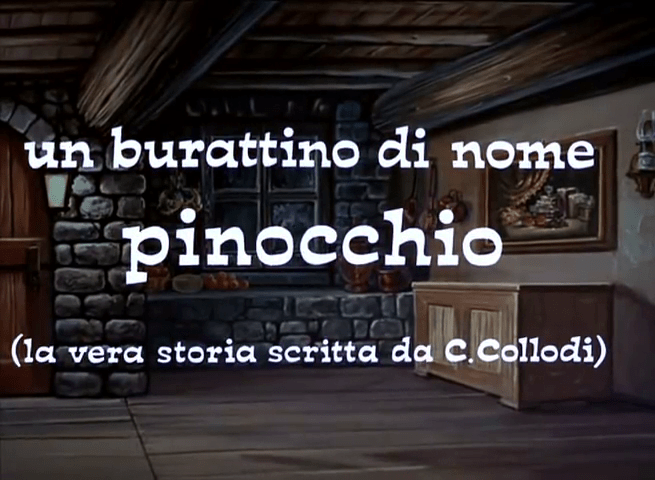
As it makes manifest from the subtitle reading “The True Story written by C. Collodi”.
Down to consulting Carlo Collodi’ heirs, his nephews Mario and Antonio Lorenzini (Collodi was actually a pseudonym surname, FIY), who ultimately agreed this was the only version of the story to be as close as possible to the spirit of the original book.
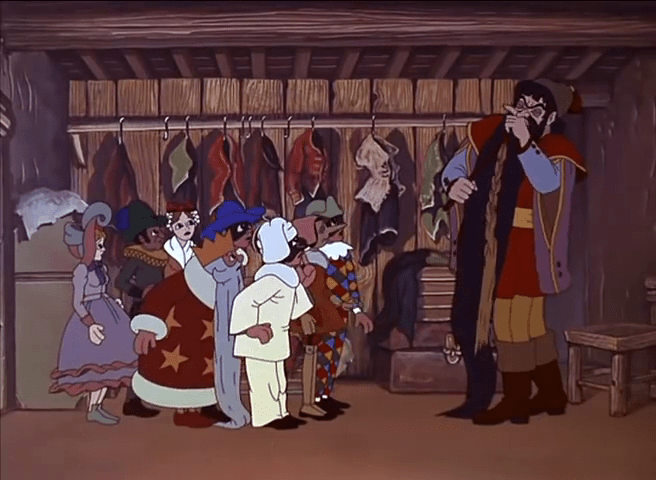
That’s commitment, and lots of it as the movie was animated over 5 years sparing no expense, going for the detailed “2 steps” system that Disney also used at the time, but intriguingly not following so much that model but being mostly inspired – in terms of style – by one of the earliest italian cartoonist/children illustrator Attilio Mussino, though there are some clearly Disney inspired rotoscoped sequences used for the more complex character movements.
Real Boy Ratio:
Given the intent of making the most loyal adaptation of the book ever, it’s quite logical to assume it has most of the darker content usually esponged, like Pinocchio’s first encounter with “Jiminy Cricket” ending with Pinocchio throwing an hammer and killing the talking animal, him getting outright hanged at a tree to make him spit out the money, even some of the Blue Fairy “trickery”, and yes, it does have all of that, i could go on but this is a review, not a wikia article, and also, better this way to avoid “spoiling” the entire thing for people that never red the book.
Though you could make some assumption on some scenes, and yep, while the black rabbits coming carrying Pinocchio’s pre-made coffin aren’t as scary as one could have assumed (or wished), the “donkey scene” (since Pleasure Island it’s not actually called that, nor an island) is still quite… noteworthy, to say the least.
Not really “traumatic” because it’s really not, and the original tale was never meant to be that, it just had a lot of graphic and often “excessive” (at least by american standards) scenes to drive home its point about obeying your parents, being proper and stuff, because admittely scaring the shit out of the kids for whatever purpose has been an effective tactic for millennia.

And while some character designs might be more generic than expected, this movie really isn’t trying to mirror or ape Disney’s adaptation, at all, as it’s distincly italian in mannerisms and tuscanian in its language quirks and various reference to famous Reinassance tuscanian (especially ones that can be still found in Florence) architecture landmarks, or choices like the Blue Fairy looking very “Virgin Mary”.
Obviously it’s not a verbatim adaption, as for time it wisely skips a lot of the minor adventures, after all it’s a 90 minutes film, nor it would have been necessarily better if it adapted every single scene, not that i need to make this clear, but just in case…
Overall, it is a great adaptation that’s loyal to the source material as it could be possibly be (aside from being made in the native country of Pinocchio), while also being a very good film version of the story (even if a bit old timey even in 1972), lovingly and masterfully animated over years of devoted hard work, indeed so well done it should make fellow fans of animation angry of how it was so badly treated both in its own country and abroad, fucked over by distributors mishandling it big time (leading to its semi-obscurity status it has today), because it could have been the movie adaptation of Pinocchio to propel Giuliano Cenci’s career even outside Italy.
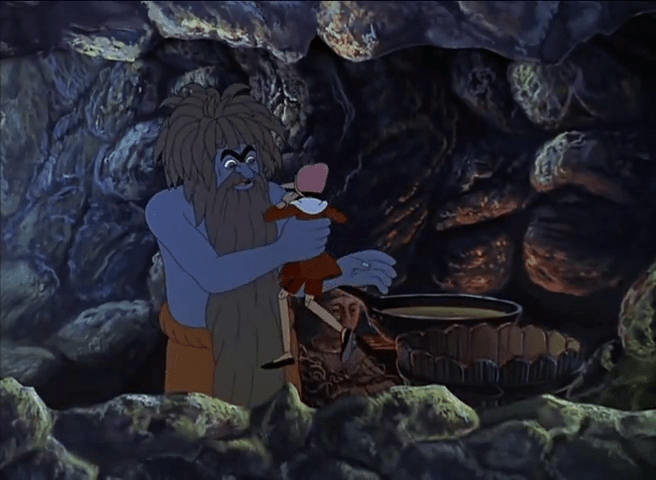
But instead of lamenting the ifs and coulds, i’m honestly so glad the movie got made at all, that alone it’s worth celebrating the opus of Cenci, whom knew better than everyone else how it must have felt, after all, as his name was already entwined with Pinocchio’s long before this very film.
Personally i find it a bit too old-timey (due to it being extra faithful to the source material) to fully, genuinely prefer it over Guillermo Del Toro’s version (or some others), but it’s undeniably more than simply “remarkable”, a great adaptation no matter how you slice it.
In 2011 it was restored and put on Youtube in its original italian language version, there is an English dubbed one done in 1978 but you will have to check for any kind of legal (or less legal9way to see it in your neck of the woods, even in its homecountry the DVD release has been out-of-print and removed from catalogues due to some copyright controvers, quite unfortunate.
 Wise Cafe (International)