

One Piece might not be a franchise that you would immediatly associate with RPGs, but like Dragon Ball its surprising how the genre is represented in their many videogame iterations, especially if we’re talking about older systems, and even more so if we’re talking about Japan-only releases, as the first One Piece videogame was a RPG on the old black-n-white WonderSwan, and more came out for both the Wonderswan family of consoles as wells as for Game Boy Color, Game Boy Advance, and even on the original Playstation.
But sadly most western fans are not familiar with some of these quirky GBC One Piece RPGs where (among other things) the Straw Hats are turned into animals, no, most likely you’ve yearned for years for a localized One Piece RPG, only to find out that it exists, One Piece: Romance Dawn, and that it’s sadly a very shit game, even worse as it’s a port from PSP to 3DS, and a cheap one too, because knowing this it makes all sense for the game to look that much like old ass.
I reviewed that one as well, but today we’re here holding hope to finally retire this status and have a big budget mainstream RPG that can make the series some justice instead of wishing they wouldn’t have bothered to begin with, with the long anticipated One Piece Odissey, developed by ILCA and published by Namco Bandai (who else?) in January 2023 to celebrate the series’ 25th anniversary.
Available pretty much on all the platforms, old gen and new…. but not the Nintendo Switch.
For the record, this review is based on the PS4 version played on a PS4 Pro.
Story is nice and sees the crew shipwreck on the mysterious island of Waford, where Luffy and friends meet two new original characters made for the game, Ado, an adventurer that is trying to solve the mysteries of the island and Lim, a little girl that also shipwrecked here, with a mysterious power that lets her take away strenghts and powers by removing the memories of people in forms of mystical cubes.
So the crew has to scramble in order to regain its abilities, by exploring the island, its strange ruins, mystical stone guardians, and also revisiting some of the most beloved narrative arcs and locations of the series, like Alabasta, Enies Lobby, and so on.

Obviously there’s more to it, making for an overall good story with a strong narrative featuring new characters that are fairly well written and a solid decent-to-good tragic villain, and the plot IS NOT entirely dependant on the Memories world, as there are regular quests and puzzles and dungeons/ruins/edifices to explore in Waford itself.
Sure, we want to revisit some of the iconic moments from the series in a RPG format, but there’s also the original storyline which is more interesting than it appears initially, some excellent and very “Eiichiro Oda” newly created designs for the monsters, and the narrative balances the new stuff and the revisited arcs quite well, sporting excellent presentation and some quick recaps to get you up to speed or jog your memory.
Though there are some issues in terms of pacing for the first part of the game, as indeed the Alabasta memory trip (the first visit to the Memoria world) it’s bloated, faithful yet also stretched, BUT it shouldn’t be taken as forier of things to come, since the later memories/arcs offer a WAY better balance in recreating the events of that arc in RPG form and making you progress at a way better pace through the narrative.
Alabasta felt like they needed to elongate an already extensive arc just to make you fulfill the expect JPRG staples of quest progression quotas or whatever, which is odd, even if it also serves as the extenction of the tutorial section, as it makes you believe all the Memory Cubes arc revisits are gonna be THAT long and overlydetailed to the point they damage the videogame experience of this One Piece VIDEOGAME.
It’s not but it makes for some skewed first impressions, which are corrected by the second Memoria visit of Water 7/Enies Lobby’s arc, and that already shows a better balance in having the events recreated for the format, while also inventing stuff necessary for a RPG and using the fact that these are memories, hence they aren’t 100 % correct to reality, thus they made themselves room to change things around in the narrative, take advantage of the characters knowing that these are memories to make the events familiar but not identical, adding something new since fans will be overly familiar with the canon proceeding and even they want some variation.
So there’s really not much reason to complain about the relatively short selection of arcs revisited in Memoria (Alabasta, Water Seven-Enies Lobby, Marineford and Dressrosa), again, since there’s also the original plot in place. Still, it’s kinda odd to have Marineford, which kinda makes sense on an emotional level, but less so in terms of gameplay, since it’s literally a string of battles, which is honestly correct to the source, but it also means there’s no exploration or RPG stuff there (at least during the first story run).

Honestly surprised they didn’t insert Skypiea, come on, it’s way more fitting than Marineford to have in a RPG, the hate (and/or unpopularity) this arc still gets it’s absurd.
In terms of gameplay, it’s a classic styled JRPG, with turnurn based combat and a simple “rock paper scissors” system of weaknesses/resistance for the characters types (Power is extra effective against Speed, Speed to Tecnique, and Technique to Power), but also throws some more modern ideas in, as you’re not bound to use characters in the order dictated by their Speed parameter, and you have them occupying different areas of the battle zone, so – for example – if you wanna help Zoro fighting a lone basque-wearing ice monkey from a different “block” of the battle zone, you gotta first clear out enemies in your area first, or use longe range attacks.
To spice things up further, often battles will have “dramatic scenes” that add special objectives depending on the situation or context, like having one or more character paralyzed, frozen, bleeding or in with little health and having to dispose of the enemies in their area that also got a bigger chance to land critical hits, or having to finish a certain enemy with a certain character, stuff like that.
Combat may feel old fashioned to some, but it’s pretty fun, fits One Piece a lot more than some of you might expect, heck, the developer ILCA managed to also work the rebound mechanic that One Piece Romance Dawn had (the only decent idea it had, mind you), so some special moves or regular attack might launch/project enemies against other enemies situated in another battle area.
Simple, but not too simple, and overall quite fun still, though i can’t deny that maybe just adding another type of fighter to spice up the “triangle system” of weaknesses/strenght among types… could have helped.
There are also special combined attacks that can be learned via important sub-quests, though, since the game isn’t that hard, you could honestly finish it without any combination specials aside from the one given after the introduction of said major sub-quests.
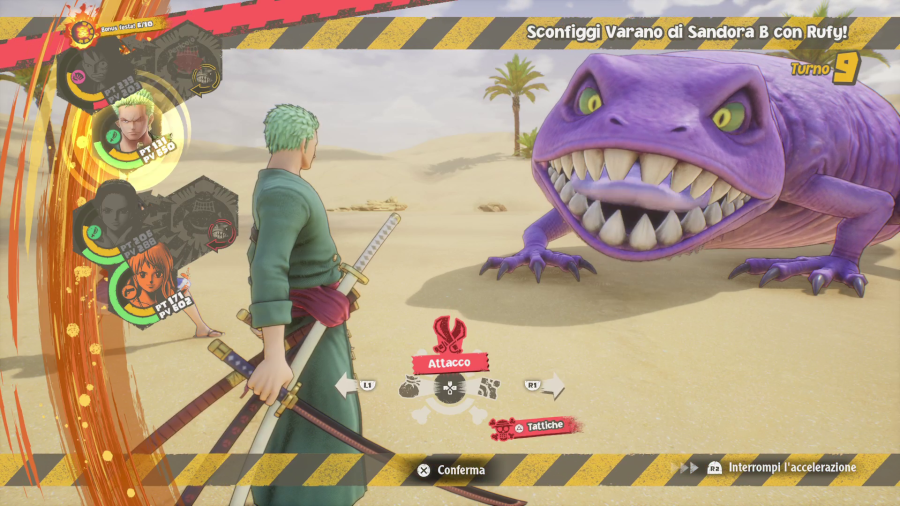
Yeah, it has to be said it’s not a particularly difficult game, boss fights do indeed offer some challenge, but since the game’s difficulty its skewed to easy side, this makes the boss battle themselves take longer than necessary/needed as boss units are hard hitting and have plenty of defense alongside the expected extra sack of HP, which on the plus side makes the usage of craftable “debuff balls” an actual useful option for combat, as you might want to exploit the many classic JRPG status ailments the game keeps, from the old fashion bleeding, burning, alongside charmed, paralyzed, confused, etc.
i’m surprised they proved to be useful and not just something i could mostly ignore, as these debuff items can lower enemy defense as well as make the enemies susceptibile to elemental attacks, meaning you can prepare a strategy around that with Nami’s Thunderbolt Tempo special, or Usop fire attributed attacks, for example, which in turn doesn’t make the crafting of items, the enhacing of special attacks (via fragment cubes you can find by winning battle and exploring) or the accessories fusing pointless, not a given due to the difficulty not being high by design.
But overall i must say i’m quite satisfied with the combat system, each character slowly makes it clear what role they function as in terms of classes and whatnot, with Zoro able to inflict bleeding with every of his skills, Nami working as the debuffer and long range attacker, Robin as the technical specialist, Luffy as the general use medium-strong short ranged attacker, etc.
My only gripe is that the range of skills you can use it’s tied to the story progression, which is good on one hand to avoid you overgrinding and unlocking advanced techniques WAY before they would even be needed, hence avoiding you accidentally making life for youself easier by accident… but on the other hand it’s kinda frustrating.
Nothing that hampers the fun in any significant way, but it can be kinda hilarious how many moves you unlock after finishing a chapter, expecially for Alabasta (given you also unlock Gear 2ND and some related moves, despite Luffy learning that during Enies Lobby, but whatever), so maybe it would have been better to have you unlock less moves but do so in a costant fashion, instead of everything all at once when you finish a chapter.

Like in the Unlimited World/Cruise sub-series, you can control all the Straw Hats both in combat and in exploration, for which every character comes in handy in a specific situation: Chopper can move in small cave-like tunnels or holes, Usop can aim and use his slingshot, Zoro can cut steel doors, Luffy can stretch himself and grapple around building and ruins, etc.
Also, some characters like Robin, Nami and Sanji can detect otherwise invisible items to pick up, ranging from lost cash, ingredients, or hidden documents of sorts. Nothing major, but it’s an incentive to switch characters around, as they will have contextual lines to indicate there’s something nearby for you to search.
Fairly simple in terms of exploration, as are the enviromental puzzles often found in the ruins or caves or dungeon like areas of Waford, though i’m not fond of the option of having an “auto-moving” function for the character traversal, since it feels stiff, not that good even when using, and it may lead to you stumbling into enemies on the overworld (it’s a classic JRPG, but not that old fashioned, you have to touch enemies to initiate battle with the normal foes) you didn’t meant to start beef with.
There are also some modern QOL features, like fast-travel points via “animal taxis”, speed accelleration if you think battles are a bit too slow (i do, and pretty much played all the combat on 2x speed) and since it’s One Piece, you can have the classic pirate parties by bonfires, which is where you acces the crafting, cooking and costume changing options.
In terms of longevity, i don’t quite get where that “33 hours” for a standard, almost completely devoid of side activities run that most reviewers seem to agree on, since it took me 60 hours to finish.
And i barely took time to do some extra stuff, aside from trying to get all treasure chests i could without the key, but then again, RPGs in general aren’t my forte at all, so i’d say the average lenght for doing the bare minimum story route it’s 40 hours affair, which is fairly respectable and it’s just as long as needed.
There are still a respectable number of sidequests to do, some opening only after the first Memoria visit, including the memory repair ones that net you new special combination attacks, collectables to find that often add something to the lore of Waford, plus bounties to undertake and various battle challenges you can access only in the post-game.

Presentation it’s excellent, technically it looks the part for a fresh early 2023 release, and it runs without hiccups or crap like that, fairly smooth performance overall, music is fairly good, with the series composer providing some orchestral epic themes alongside the more typical One Piece styled type of tracks for exploration, and the Japanese VAs knock it out of the park as expected.
Overall, One Piece Odyssey it’s quite good, especially if you waited a long time for a classic JRPG take on the adventures of Luffy and company, but also stand a solid, good game if you aren’t too invested in One Piece, with a good original story and decent original characters to compliment the revisit of the classic story arcs…. well, some of the classic story arcs, as for some reason Marineford is featured in a One Piece RPG but not Skypiea.
The JRPG gameplay is classic down to turn based combat, but with enough deep and modern commodities to be very enjoyable for anybody, which fits with the overall difficulty more tuned to the “easy” side of things, to the lamentation of players that might have wanted a bit more challenge or more depth to the combat system that still it’s not shallow, at all, and the new location of Waford has some intriguing mysteries and surprises of its own, making for an experience a lot of people have waited for, especially as the only One Piece RPG we got localized westward before was the shitty One Piece Romance Dawn on 3DS, and Odyssey by itself undoes the damage that crapfest did, so if that’s not a glowing recommendation…
I will also be covering the DLC, Reunion Of Memories in its own review, coming later this month.
 Wise Cafe (International)