

We cover surprisingly little Lovecraft content, so let’s rectify that a bit with one of the earliest film adaptation of a popular tale of Mr. Racist, The Dunwich Horror, arguably one of the most well known stories of his and hence one of the most adapted alongside The Color Out Of Space, The Shadow Over Innsmouth, Herbert West- Reanimator, and obviously The Call Of Cthulu.
Speaking of official adaptation, at the very least, and even so this is just the second oldest film adaptation, as Roger Corman (whom also was an executive producer here) did a loose but credited adaptation in 1963’s The Haunted Palace, part of his Edgar Allan Poe series but in this case just borrowing the name from a poem later tied to Poe’s Fall Of The House Of Usher, in reality adapting The Case Of Charles Dexter Ward.
And loose adaptation of Lovecraft’ works was the name of the game at the time, which was when his work finally started gathering popularity and beginning his revival to a staple of horror and science fiction that is today.
So since this is the first properly marketed wide spread film adaptation, i’m willing to cut it some slack as the “first (proper) try” of adapting material that struggles to be adapted in audiovisual form, we’re already had the “cosmic horror is difficult to make on film” talk before (when talking of 2001’s Dagon by Brian Yuzna, if not mistaken), i’m not gonna repeat myself this time.
Before we go any further, let’s discuss plot.
A woman is giving birth in an ancient room, observed by an elderly man and two creepy elderly women, visibly and udibly struggling to deliver the child, until she’s led out.
Back in the modern era, we’re at the Miskatonic University of Arkham, Massachussets, where it’s being celebrated the retrieval of an unique, rare occult book known as the Necronomicon, and a young strange man, Wilbur Whateley, approaches the professor and students, asking to see the book, which one of the students, Nancy, approves.
Nancy eventually befriends Wilbur, despite the warnings of his professor due to the Watheleys sordid family history that has made them outcasts in their town of Dunwich, and when she gives him a ride home to the strange old Whateley manor, she ends up staying, as if hypnotized.
Henry, Nancy’s professor, and her friend are wary and start investing Wilbur and the Whateleys’ history further, which involves pagan rituals, sacrifices, stories of Old Ones trying to break into reality, and the odd circumstances about Wilbur’s mother, Lavinia Whateley, and his undocumented birth…
One of the reasons this is often the go-to Lovecraft story to adapt is because its’ actually one of the few with an actual, unambiguous ending where mankind somehow defeats the cosmic horror’ plans… so it’s kinda funny how they opted to instead keep Wilbur as the main antagonistic force through the movie, as this pagan priest hellbent on opening a portal for the Old Ones, when he actually dies mid-way through the original story, and the whole virginal sacrifice so cosmic deities can enter our plan of existence… also was not quite in the book.
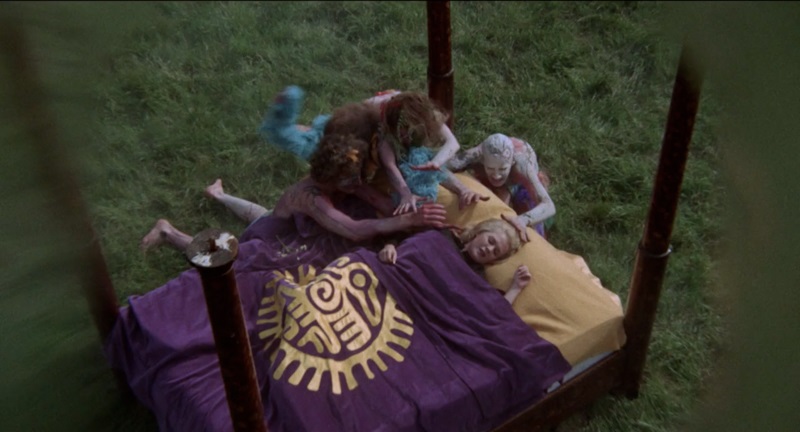
There are many other small and not so small differences, like Wilbur’s granpa, or Wilbur himself just looking like a normal man instead of the weird satyr-like caprine chimera he is revealed to be, but again, this is what you call a loose adaptation, a common denominator in Lovecraft based film, like the aforementioned (and already discusse) Dagon from 2001 which is actually a mash up of mostly The Shadow Over Innsmouth than the actual Dagon short story.
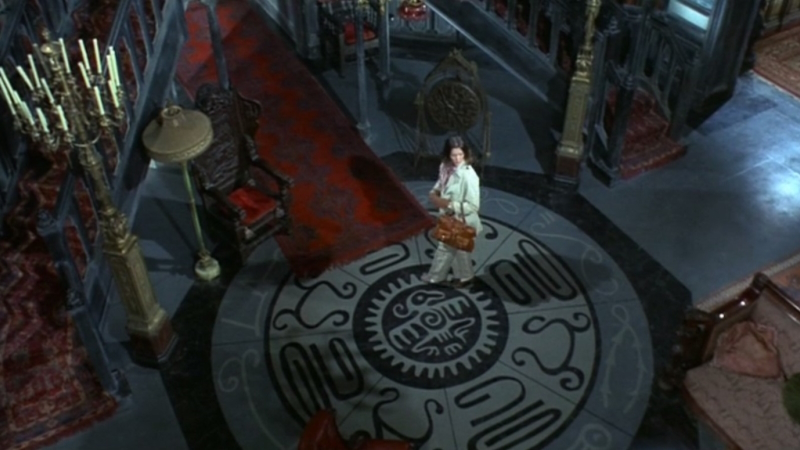
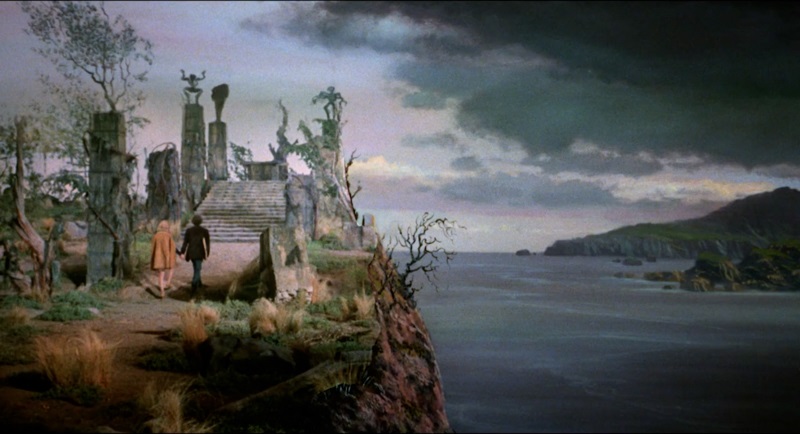
That said, it’s actually quite faithful the adaptation, most of the main plot beats are there and recognizable, there’s a good atmosphere to the town of Dunwitch, and the set design is gorgeous, remind one of the excellent work already seen in Corman’s Poe series of films.
Shame it’s a honestly dull movie to watch, with some almost-good casting but many performances that are just really unremarkable at best, or untentionally goofy, like Wilbur’s grandpa, that supposed to be a old warlock with unnatural energy for its age, but sounds like a wheezing old bag that’s about to crumble if the wind is too rough, to say nothing of how he dies, trying to stop Wilbur by shaking a staff at him, failing, and then breaking his neck by falling down the stairs.
Even the way i’m describing it sounds more dignified than what it actually looks like, same as any attempt to describe the fight Wilbur has with the security guard while he steals the Necronomicon from Miskatonic University… as oddly realistic, but also very Kirk vs The Gorn Captain.
Which in a roundabout fashion makes sense, it’s hard to feel this is an immortal tale of cosmic horror glancing the veil of our reality set in arcane past when everything is also heavily tapping into the then modern sensibilities of the late ’60s, with the whole verginal sacrifices, crazed cults, erotic scenes of “naked in commas” actress Sandra Dee in her first adult role, and plenty of psychedelic poster sequences with high contrast colors and such.
Again, everything IS (by definition and reality) a product of its time, whatever that time is, and it’s not necessarily for ill, i feel the psychedelic imagery fits perfectly, as do the weird tunes, not so much the sexual angle but “it was – literally this time – the “70s” and the genre conventions of witches, pagan cults, and sex orgies was also a practical way to sell it to audiences.
A good adaptation but not a good movie, it’s hard to say that when it feels longer than its 87 minutes runtime, when the performances are bad, mediocre, or almost good but the casting seems to conspire against making the whole thing believable, the characters are underdeveloped at best, the special effects are unremarkable, when there are some (ironically a good choice for some of the later events in the film), and the final confrontation retains some elements of the book but it’s also a bit ridiculous and rushed, again, sharing some of the issues with Corman’s Poe adaptations.
It’s quite the mixed bag situation if i ever saw one, but still, even it’s arguable overall mediocrity and not much else, it’s an interesting piece of horror cinema history, especially for fans of Lovecraft, so it’s no wonder Arrow Video re-released it on Blu Ray with a solid 2K restoration from MGM’s original negative, alongside the expected bounty of commentaries, behind the scenes, and such.
If nothing else, the 1970’s film adaptation of The Dunwich Horror it’s a case study that what makes for a good adaptation of a specific source material, does not in turn make for a good movie.
And i’m definitely not alone in wishing they took another crack at it, since another film version of the story was released in 2009.
Maybe if we’re doing a Lovecraft film marathon-retrospective, who can say..
 Wise Cafe (International)