

Since SEGA announced its clear intent to unsurprisingly milk the series for all its worth and do so before the 3 anime films hit (after all, this isn’t Dragon Ball or one of Jump’s big shots, so after it ends interest will peter out faster than some of you might imagine) with a Hinokami Chronicles 2 announced earlier this year and having just come out for all consoles (Switch aside), i figure we talk about the first game, which had been quite elusive to secure at a reasonable price, at least it was in my region for a good while.
The PS4 version to be precise (played on a PS4 Pro, to be even more precise), all updated and with all DLC characters snatched on sale, btw.
Here it’s where i usually discuss the series/source it’s based on, which might seem silly right now, since Demon Slayer/Kimetsu No Yaiba has been pretty popular, even outside of the hardcore anime circles, but i feel it’s a series that got extremely lucky, for many reasons, and one where the anime had to do a lot of legwork to popularize it, which in itself is kinda par for the course, the usual for new shonen series that become the next big thing, but let’s just say ufotable wasn’t served “prime Kobe beef” material to work with…
My feelings for the series as a whole aside, let’s discuss plot.
Hinokami Chronicles, in very typical modern anime videogame fashion, adapts the series up to what was the currently aired material, as in, made to come in hot after the first season of the anime aired, and adaptating that (but including the events of the Mugen Train anime film too) in order to conventiently carve out sequels after the following seasons come out if this first iteration is successfull, which in this case mostly was DLC characters from Season 2, the Entertaiment District Arc, without story content, for convenience and necessity/need to not accidentally spoil the arc to people that might just have seen Season 1 and Mugen Train, or possibly just have witnessed the story and events as depicted in this videogame.
It’s usually this or an original plot made specifically for the videogame, but it’s also an anime arena fighter, so just recreating/retelling Season 1 it is, let’s play it safe.
On this note, the basic gist of Demon Slayer, not that 99 % of you will need it, but here it is.
It’s the Taisho era in Japan (basically pre WWII, with some modernization taking place but mostly relegated to specific rich areas and foreign technology introduced), and Tanjiro is the oldest brother of four, and helps out his father in doing jobs and chores necessary to fed an entire family living in the middle of the woods, no easy task, especially with humble, pastoral jobs.
One day Tanjiro goes out to fetch wood but it’s shocked to find his entire family massacred, only his older sister Nezukosurviving, but as a demon, and in order to both take revenge and find a way to turn Nezuko human again, he joins the Demon Slayer Corps, an order of warriors that have been secretely fighting demons for centuries…
Speaking of being “creatively cautious”, you can hardly play it safer than asking Cyberconnect2 to develop it and basically ask them to do Naruto Ultimate Ninja Storm again, but with this other shonen manga-anime license and published by Sega.
Since i didn’t play the Naruto Ultimate Ninja Storm sequels (i did enjoy the first one back on PS3 years ago, when it wasn’t padding itself out to hell and back), i might feel the burnout less than most, but yep, even so you can tell it’s by Cyberconnect2, since they still have that cinematic flair and usage of QTEs to deliver it, alongside a fighting system that has all the expect hallmarks of an anime arena fighter but also tries to incorporate elements specific to the series being licensed.
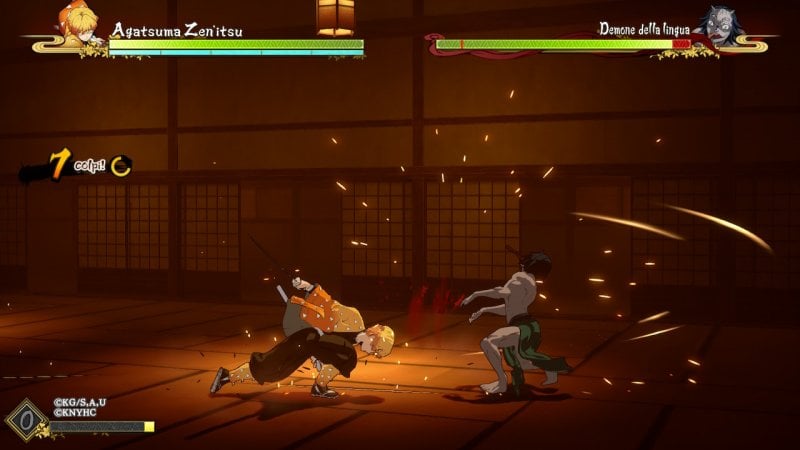
It’s still that kind of affair, down to the matches being between teams of two characters with the other usable for assist attacks or clutch escapes, but there is some depth, with parries, pushing moves to create some space/room, chases, there’s no substitution or instant transmission technique, so blocking and evading are more pronounced, the power up state here can be transitioned into a special unblockable/ultimate (which can be charged up to three levels) or you can go “burst” to have unlimited special attack energy for a small period.
Balance it’s about what you’d expect, but there have been efforts made in this deparment: for example to avoid the infinites loops of combos, there is a combo window gauge that tells you how long you can mantain a combo….shame it doesn’t make any exceptions so even if the hit would connect and keep the combo going, that will finish/stop because the timer/gauge said it’s time over, regardless, so it feels kinda arbitrary as multi-strike attacks might still have the combo stopped despite being mid-execution and making contact, meaning some character are more penalized by this choice than others due to this system.
It’s an odd choice, alongside the charged attacks needing a direction/waggle and THEN holding the attack button instead of just having to hold the attack button, but it’s not a deal breaker, and overall, it’s quite the decent-and-above combat system, especially considering most of the cast is made of swordmen, and most importantly, it’s fun and easy to grasp, without being banal as with Jump Force or J Stars Victory, there’s definitely a better gameplay here, no questions about, even if does retain the typical anime fighter fashion of being no real combo inputs to learn, since all characters share the same “attack mashed repeatedly” combo string, despite having different movesets tied to them.
… mostly.
I would say it’s not as good as Cyberconnect2’s Jojo All Star Battle, for example, and i’m VERY tempted to claim it’s still better than the Jusutsu Kaisen anime fighter… but i haven’t played that yet, and probably won’t until i read/watch the thing and hopefully physical copies of that one will have become cheap by then, as reception isn’t that great for that one either.
The roster isn’t exactly a forte, as many characters are clearly there to pad out the characters slots, and i say i say this even without including the reskins/different version of the protagonists like Tanjiro or Nezuko from the Kimetsu Academy spin-off series (which occupy 5 slots altogether and just have a different Ultimate and some animations but behave exactly like their normal versions), since – alongside the expected multiple version of the main characters – we have Udororoki and other just play similar if not identical as any other “water breathing” user like Tanjiro, or Sabita and Makomo.
Yep, those two alone make it clear how desperate Cyberconnect2 was to fill out the roster above 12, but then we have them include Murata… yes, one of the generic secondary as hell characters with generic “demon slayer fodder corps” design that appears as one of the survivors during the attack on Mount Natagumo, remember him? Most likely not, but he’s playable anyway, and it’s generic to play as he looks, but curiously he isn’t a clone of others. How ironic.
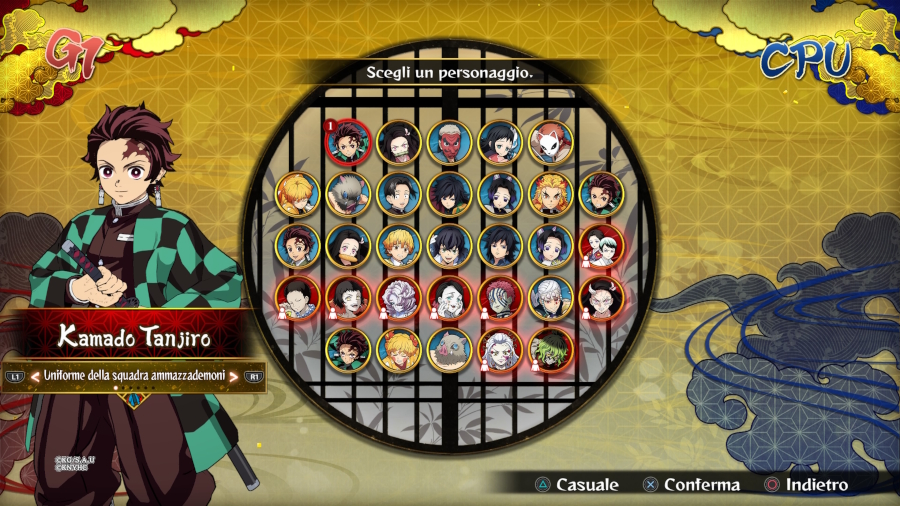
It’s also clearly indicative of how rushed this was how all the 6 main demon villains characters… had to be made playable via a free software update, despite being present in story mode, but on the upside demon characters have their own specific quirks and mechanics (Nezuko being the exception for story reasons), and there were paid DLCs adding Daki and Gyutaro (alongside other versions of the main cast) that appeared in season 2 of the anime, the Entertaiment District Arc, that didn’t come with story content, for the reasons explained before.
Speaking of, story mode is comprised of cutscenes/memories (used to flesh out the narrative more, since it doesn’t exactly starts at the very beginning), done in well executed cutscenes using the pretty good looking in-game engine and well cel-shaded models, with the occasional ones that do use footage from the TV series (mostly used for the “memory fragments” cutscenes made optional as a background to retell those events, when it doesn’t do a theathre thingie with the characters).
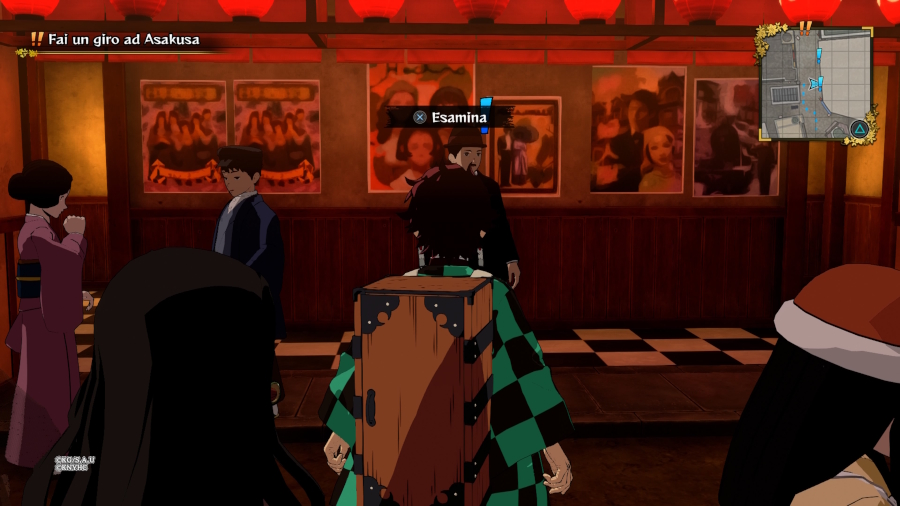
And obviously, 1 vs 1 (or 1 VS 2) fights, that or more adventure-esque style affair that have you have run around interiors, exteriors or small hubs where you mostly have to talk to NPCs, go where you’re told (with the “scent mechanic” used as a canonical waymarker), with some occasional fights against minor or generic demons, and the boss fights which had some story specific gimmicks (like the boss enemy having a “weakened state” they remain in after doing some special moves), since this is a single player only mode, after all.
The “exploration” bits… mean well but basically boil down to handling a slow moving character at a snail’s pace in some confined hubs where you can/have to talk to NPCs (or face the aforementioned generic demons, in order to give to some action outside the pivotal story fights) in order to progress, with some optional sidequests and some glubs of Kimetsu Points to grab, alongside memory fragments which unlock the aforementioned optional cutscenes.
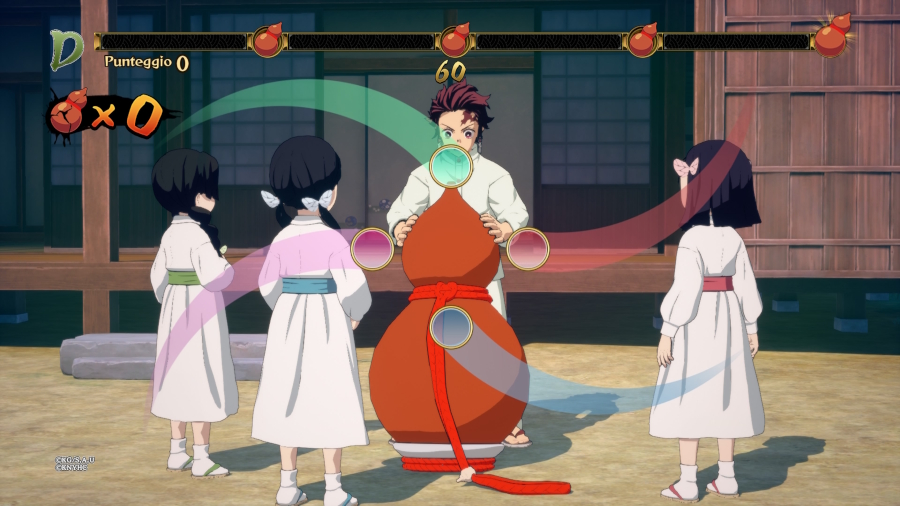
And some mini-games thrown in for variety towards the end.
It tries, i will give the game that, it’s not just content in peppering some static portrait of the characters vomiting text before and after a simple string of battles, but the exploration sections are mild at best, and regardless of how small or big the areas you can potter about, you’d wish there was a toggle or button to run faster through them, and that remains true even when you’re given a character moving fast or the same character now actually running (depends on the story context).
But it’s also better than some of the padding the first NUNS did to avoid you going through the story missions too quickly. I do not miss shoving around boxes and doing fetch quests for what felt like fuckin hours just to made the story move forward an itsy bitsy. Maybe.
The narration itself isn’t bad, it opts to do the usual focus on the important moments of the first season (plus the Mugen Train film that does serve as a proper cap leading into season 2) and each mini-arc it contains, foregoing most of the background and “fluff” in order capture choice events, the “bullet points”, the digest if you will, though to give credits they did choose the more important moments for the sake of making it work as a videogame’s story mode.
Yes, there was arguably enough material to make a more lenghty, detailed and overall less rushed adaptation, but it could be worse. It could be Avatar The Last Airbender: Quest For Balance.
Jesting aside, presentation it’s great, there’s both the original Japanese and the English dub, i went with the latter since i didn’t hear it before… and it’s quite good, i don’t like some of the dub voices, as in, especially, especially Inosuke’s, i kinda get why but i don’t feel it fits for the better.
Regardless, story mode doesn’t take very long to beat, 4 hours max, 8 if you do all the optional battles and see all the memories/cutscenes made optional but actually there to basically flesh out the narrative, but still, it’s a bit famished, especially when you’re asking 60 bucks for it, and it’s not like the sidecontent and extra modes make really up for that.
Though the story mode is as expected/usual required to unlock the playable roster, makes sense, you can technically unlock some characters earlier by spending Kimetsu Points you gain by playing (and playing ONLY, there are no microtransactions), but since they are also used to unlock extras such as concept arts, extra costumes, extra arenas (the latter costing a lot of Kimetsu Points), it’s simply faster and more efficient to unlock most (if not all) playable characters the normal way.
But yes, the rest of the content sadly is in line with the barebones actual roster of playable characters; you can play versus, local or online, play against the CPU, there’s the expected training mode with settings for the CPU dummy, master challenges… which aren’t exactly what you think, i figured they were akin to the advanced tutorial missions where they make learn advances combos, mechanics and such… but then again, there are no SF or Tekken style strings to remember here, so they’re just matches against a more compent CPU “master” with extra objectives to achieve for extra Kimetsu Points, not completely useless, but still.
there are online missions and ranked matches, but still, a bit too little content, and no, the “Rewards” menu is so obviously a way to obfuscate the lack of most expected modes, like, survival or arcade (the Archive is always nice to have but it’s not a real “mode”, let’s be honest), and the way the story mode content is laid out is there to make it feel like it’s way bigger than it actually is.
So yet, indeed it does suffer of the usual problem plaguing these anime fighters based on popular IPS, as Hinokami Chronicles feels more like Cyberconnect2 (most likely rushed by Sega to have this thing out ASAP, wouldn’t be out of line for these games) being a “foundation release”, laying the groundwork for a good game that still doesn’t feel feature complete… that would be the sequel, which did come out a few days ago at the time of posting, and i hope can deliver, because there’s definitely potential to make a good fighting game with the material at hand.
This one, as it is, it’s not bad, though, actually it’s decent, better than some of the tripe like Jump Force (and i assume the Jujutsu Kaisen one) or J Stars Victory, even if really similar to the developer’s acclaimed Ultimate Ninja Storm series, though i only recommend giving it a punt if you like Demon Slayer AND can get it for 20 bucks or less with all DLC on sale, but it will most likely be made obsolete by its sequel that’s launched worlwide today.
 Wise Cafe (International)