

You think you know the depths of the Playstation 2 library.
You don’t. You just don’t.
If this wasn’t the case, a title like Bujingai: Swormaster would have been covered by gaming Youtubers as a “forgotten gem” to the point it’s not forgotten at all anymore.
And yet, 99 % of you before know never knew there was a PS2 era hack n slash in the vein of Devil May Cry but where you play as sci-fi wuxia Gackt.
Again, the PS2 library is so big we still are finding more obscure titles to showcase.
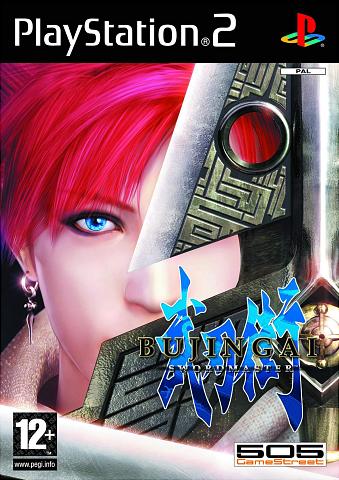
Personally, i remember seeing this one a lot in bargain bin cases after a while, since it was distributed here by 505 Games/Gamestreeet (figures since they are an Italy based distributor), which back in the early 2000s were famous for mostly peddling ol’ budget games/shovelware by the bucketloads, so that didn’t help, but at least a PAL copy is fairly cheap and easy to find still today.
Can’t say the cover helped because sure as hell the general public wasn’t gonna go “is that Gackt?” after looking at the box art.
But yes, he gave right to the teams to use his likeness for the main character, Lau Wong, a wuxia hero that has to do the usual: sky surf on an ethereal cloud while doing the usual wuxia ballet-combat aerobics and eventually go back to Earth, 100 years after an apocalyptic event wiped out most of the population while giving survivors powers, to rid the planet of a demonic army that has holed up in the asian city of Bujingai.
And since it’s a martial arts inspired game, it just happens the head of the demon army is a former fellow martial arts student turned rival that has gone evil, as you do in these.
Most of the lore from the Wikipedia page i assume it’s taken from the manual (which i do have but is sealed away in the box somewhere i don’t remember), because sure as shit the game doesn’t really explain much, and i’m not even sure the fine details add up.
Yes, it’s cool that your first minutes playing are used by the game for a montage that does a proper starting credit roll leading into the title reveal… but then immediatly after that starts a cutscene that begins with “300 years later”…. later of what?
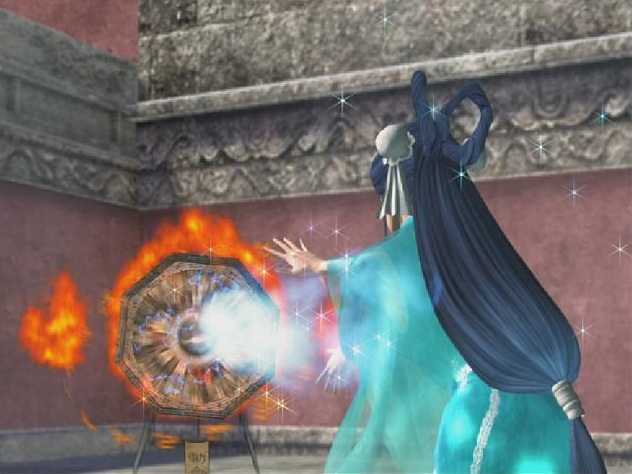
I assume after the other event cutscene, a flashback where Lau remembers his training with his kung fu master 4000 something years ago (maybe it was 400 years ago, doesn’t matter anyway), because i guess the apocalypse did give him pseudo immortality, why not?
That aside, the plot is indeed as thin as it sounds, it’s basically a soup of wuxia cliches as the eye can see, and it definitely prioretizes spectactle over any proper plot or narrative clarity, heck, i had to replay the ending cutscene just because it’s not nowhere as self explanatory as it think it is, but it’s fun nonsense (even when sudden in-engine cutscenes brashly happen to explain some things to you mere seconds before disaster does happen), and its got pizzaz, definitely.
Being meant to celebrate Taito’s 50th anniversary, they did pull all the stops in terms of style too, using their in-house band, Zuntata, bringing in Toshihiro Kawamoto, the character designer for Cowboy Bebop, and Trigun’s scenario writer, Yosuke Koruda.
One hell of an ensemble.
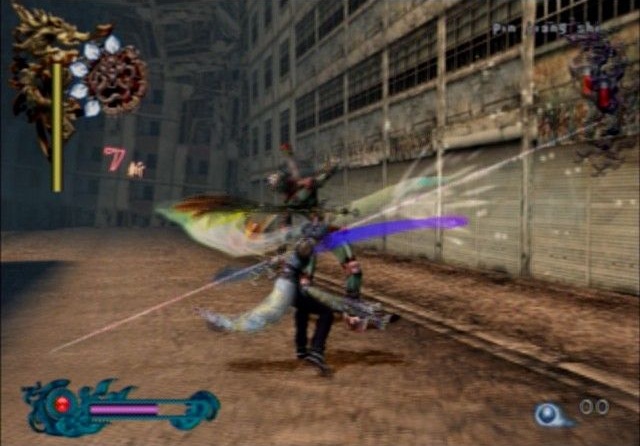
Gameplay has been compared to Devil May Cry and Otogi, and while i sadly haven’t yet played Otogi, the DMC comparisons are there, but the wuxia movies inspiration and various mechanics do manage to make it stand out as its own thing.
It’s a bit odd though how the game basically starts you off by letting you choose if to do the tutorial for the movements, combat, magic and the surprisingly intricate platforming and aerial manouver…..by not letting you do the actual tutorials.
There are many, and you can revisit them later in the dojo area… but the tutorials are actually just videos they made explaining the various mechanics.
It’s not even that they don’t explain stuff properly, they do, its just weird.
And in a way you’ll need them, because the combat system is quite good and has a counter attack mechanic that fits perfectly the wuxia theme, it’s pretty damn nifty for a 2003 game, and still is pretty damn good today, as is the combat system overall, that includes magic “beam struggles” of sorts, various way to combo into fast long chains, area of effects spin attacks or even a series of mid-air kicks, it’s pretty dang cool.
The counter attack system is still unique today because you have various “combat gems” symbol on the main UI that represent your ability to counter enemy’s attack, but to do so you must lock onto an enemy, let him attack, so a clash will commence, and then you can use counters or do evasive manouver in air or on the ground.
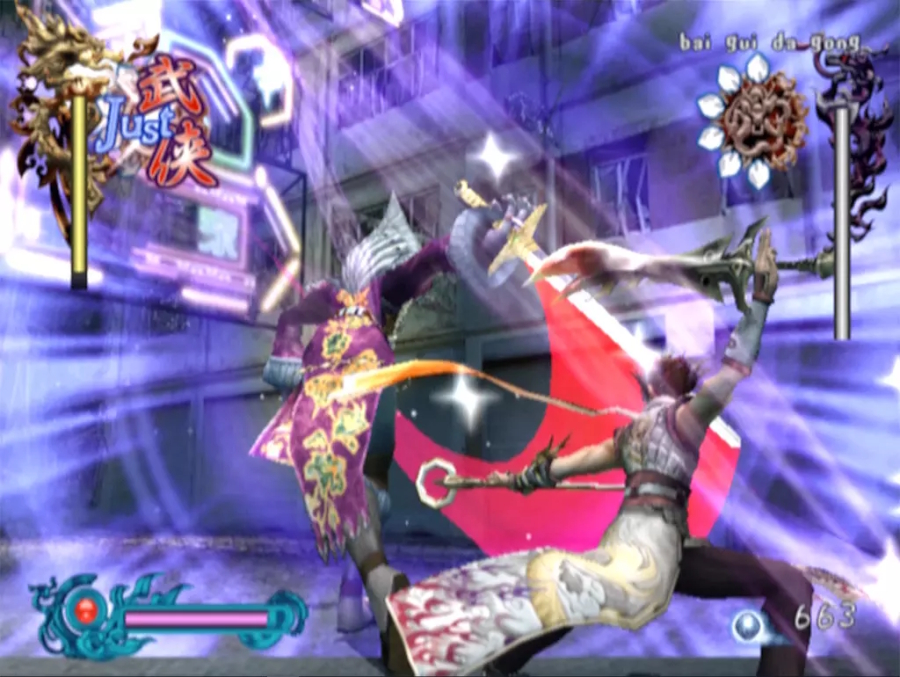
So it does encourage this system without making you overreliant on it or making it so easily exploitable that challenge becomes moot, because even being on the defensive will consume the “counter gems” on the UI, even more if you let an enemy take the upper hand on the clash by countering your counter or keeping up with the blade furries.
Gameplay stars decent but shines in boss battles even with the mini-bosses or any foe that can counter like you, and forces you to try out strategies and not just do the counter mindlessly, as it often is not enough to get the upper hand, and the wuxia style aerial moves often help in that, so it does manage perfectly to have you perform stylish moves and aerial flourishes.
My only gripes with the gameplay lie in how, even with the extra magic spells and moves, you still haven’t got a proper way to get out of being stunlocked, which isn’t complete bullshit as this goes for most enemies, but even mini-bosses have moves that let them break out of a combo, and there’s no unlocking new moves. You can improve the combos lenght, among other things, improve your “counter gems” limit, and i must confess i went for a lot of the game unaware that i could indeed spent what i assume were “soul orbs” left by fallen enemies, that looked like currency, because the italian translation was so literal of a translation it did actually lead me astray.
See, you can spend the “soul orbs” by going to the mirrors/portal to access the levels and select “Power Up Settings”.
Yes, that would seem obvious, but i assumed it meant some boot up options since the Italian translation of the “Power Up settings” option was too literal and hence it strongly implied it was some advanced “starting options screen”, but nope, that is where you can spend the souls thingies to upgrade attack, health, magic, combo lenght/proficiency and the “counter gems” limits.
It’s actually very similar to how the old Onechanbara games did it, you can assign points but you level up each stat if you have enough to reach the threshold, it’s quite fine, but NO, the game never tells you that you can just do that., it never says “how about spending those soul points/orbs?”, guess the manual did but mine is somewhere in a big crate in an attic or something.
YES, i almost went through 5 of the 7 levels the game had without upgrading the stats, i was stuck on level 5 boss, thankfully you can go back to the hub temple and then resume the current level from the last checkpoint, so i didn’t have to play the level from stratch.
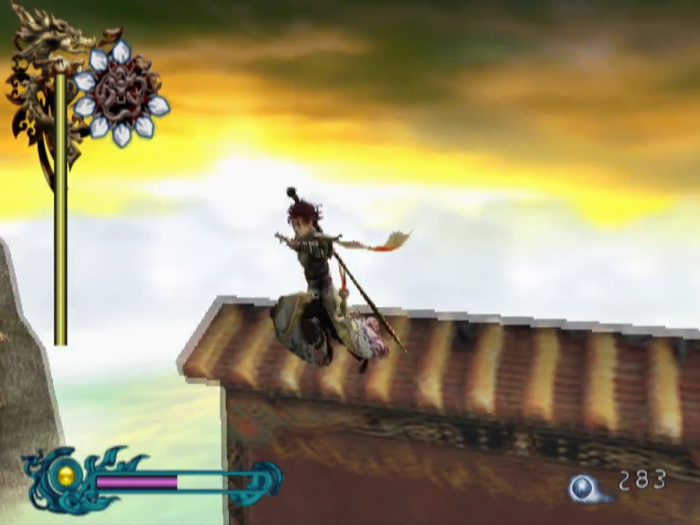
Speaking of, the level design does many familiar things, like locking out a door until you kill all the enemies in that area, requiring to find and use key items to open doors, there’s also some puzzles to resolve, and especially a lot of acrobatic platforming to do, very much in the vein of Prince Of Persia The Sands Of Time, minus the time reversing power but with a lot of wall jumping manouver and even a brief air glide.
I do like that every stages throws in some new little gimmick or challenge, i wish the game recycled bosses less, that’s a pity, and annoying since the stages are few but are packed and often have some unique gimmick, like the snow one having a segment that force you to move because the spirit demon aura drains your health, very Shinobi PS2 of the game, and after that becomes a search for keys to move/activate pieces in a big ass central temple.
Thanks to a mini radar map there’s always a general sense of where you should go, which will be needed as levels often have a lot of verticality, maze like sections and room for exploration, but not so badly done that you get straight up lost in them, regardless if you pay attention or not.
Speaking again of the platforming, the combat can get pretty tough even on Normal, some boss fights can be very hectic…. but the plaforming can be just as hard if not even more so, which is a weird issue to have for a game that’s more DMC than Prince Of Persia SOT, but i died a lot more of jumps than fights in level 5, for example, to say nothing of the final level which is mostly a sequence of the hardest section of platforming ever, that require you to master the system, figure out some tricks they do not explain, eventually you’re forced to basically take chances at the hints thrown by the game and do stuff that you were never proper prepared for.
really, combat can be quite hard but platforming is even harder and tougher, maybe if they let you use healing items from a menu it would have culled down the number of game overs/deaths notably, and do not let the relatively small number of levels fool you, as sometimes they are so big they could have been easily split in two, like the final proper level could have been 2 separate ones, especially with the insanely hard platforming and challenging enemy gauntlets for good measure.
Yet, it’s not an overly long experience, at it can beaten in 8/9 hours at the standard difficulty setting, but there are collectibles medals that unlock various stuff, like a gallery for the in game character models, interviews with the creators, extra difficulties, a new game plus option, though it’s worth replaying as the game does actually changes the layout and the enemies types and presence in the Hard and Extreme difficulties, properly upping the challenge instead of just beefing up the enemies health and damage output, and a lot of the Tai Chi medallions/medals can only be found in the harder difficulties anyway.
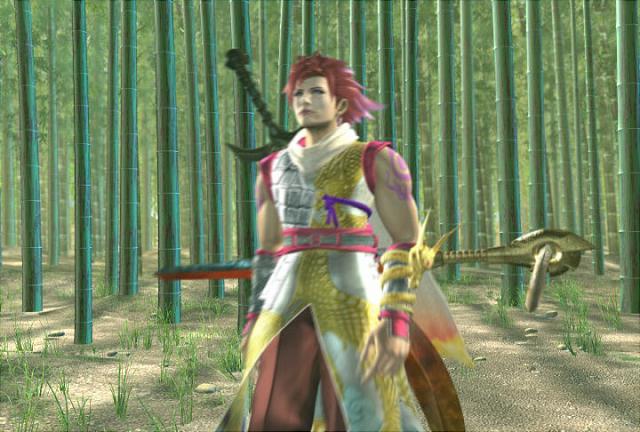
Overall, a tough but pretty dang good and fairly refined for 2003 3D hack n slash that’s very stylish but also not shallow and rewards mastering its wuxia inspired combat as well as it’s acrobatic platforming challenges, which can get very tough, even more due to a decent but not perfect camera, which is actually more of a hassle for platforming more than combat.
Despite these issues, it’s one i highly recommended, even more so as it still seems to be fairly cheap to find an used copy online, so you won’t break the bank to play as wuxia GACKT.

